
Acetyl hexapeptide-8Cosmetic ingredient
What is Acetyl hexapeptide-8?
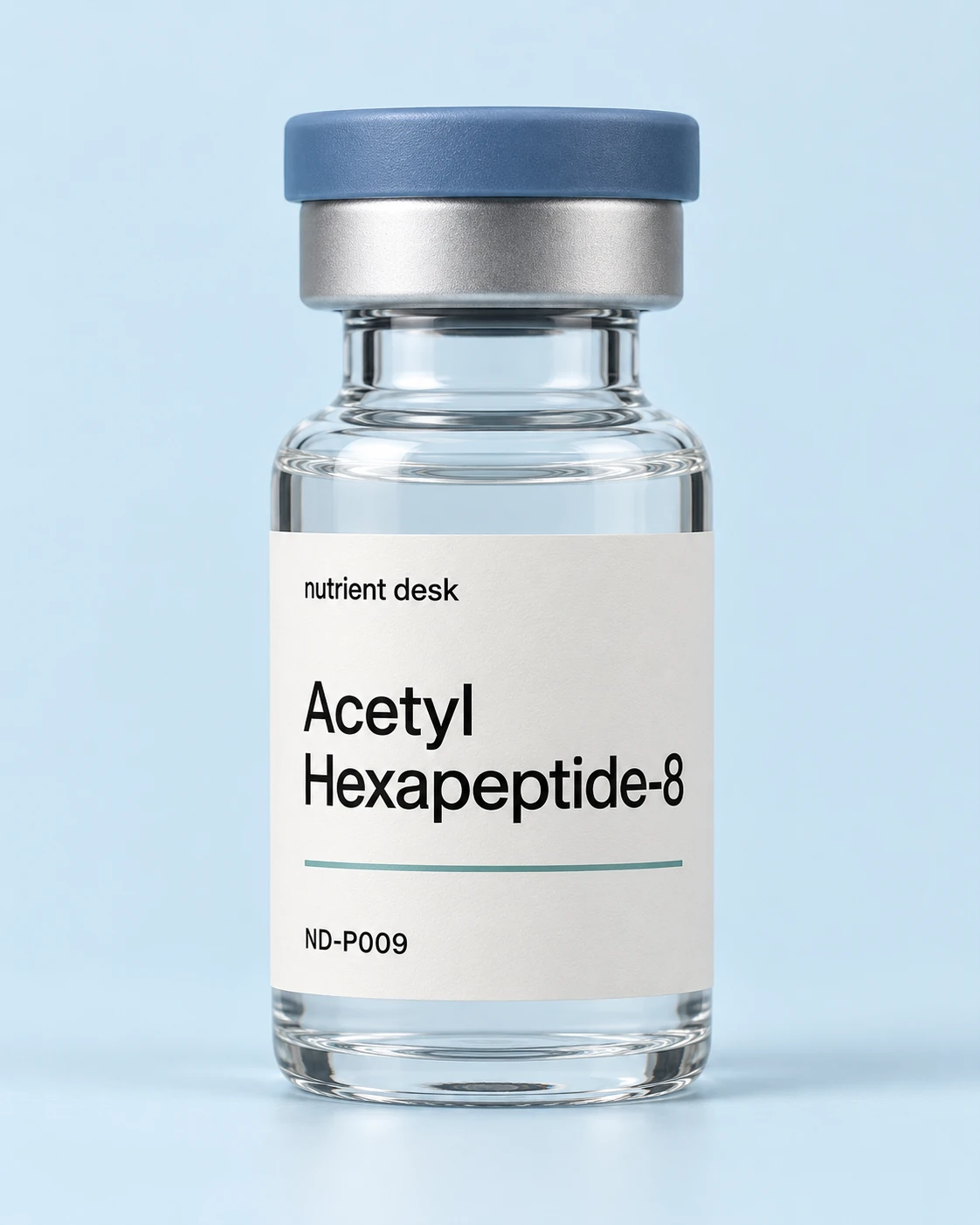
Acetyl hexapeptide-8 is a synthetic six-amino-acid peptide used in creams and serums for expression lines, especially around the eyes. Argireline is its familiar trade name; acetyl hexapeptide-3 is an older ingredient name.
It is a topical cosmetic ingredient. Its clinical evidence concerns the appearance of wrinkles, rather than treatment of a skin disease or the effects of an injection.
How it works
The peptide was designed from part of SNAP-25, a protein involved in releasing chemical signals from nerve cells. Laboratory work proposes interference with the SNARE protein complex. Whether a cream delivers enough intact peptide to the relevant nerves remains unresolved; a visible skin change would not, by itself, prove muscle relaxation. 1 6
Effects studied
Wrinkles around the eyes
A 2013 randomised trial assigned 60 people to Argireline or placebo in a 3:1 ratio for four weeks. Clinical assessments and skin-replica measurements favoured the tested Argireline preparation. The reported 48.9% efficacy figure is an assessment result, not a 48.9% reduction in wrinkle depth. 1
Evidence: Small positive placebo-controlled trial
Added benefit over a moisturising serum
In a 2023 double-blind study, 19 women used a hyaluronic-acid serum with Argireline on one side of the face and without it on the other. After four weeks, the between-side wrinkle-score difference was not significant (p = 0.829). 5
Evidence: Small split-face study; no added benefit detected
Delivery through the skin
In a laboratory study of excised human skin, most peptide stayed on the surface. About 0.22% of the applied amount was found in the outermost layer and 0.01% in the epidermis; none was detected in the dermis. This is evidence about one formulation and test system, not every serum. 6
Evidence: Laboratory penetration study; not a clinical benefit
What does the evidence show?
Human findings are mixed. A small placebo-controlled trial reported improvement in eye wrinkles; a later split-face study found no extra benefit from adding Argireline to a hyaluronic-acid serum. Laboratory penetration findings raise a separate delivery question. The results apply to the tested preparations, not to every product containing the ingredient. 1 5 6
What the ingredient is meant to do
The peptide was designed around part of a protein involved in releasing chemical signals from nerve cells. Laboratory work suggests it may interfere with that signalling machinery. A cream must also deliver an active form of the peptide to the relevant tissue. The proposed mechanism does not establish that it can.
What studies in people can tell us
The retained clinical paper examined a preparation for wrinkles around the eyes. Its result belongs to that formulation, application period and method of assessing the skin. It cannot simply be transferred to another concentration or to all facial lines. Independent replication would make an appearance claim more dependable. 1
Why “topical Botox” goes too far
Botulinum toxin injections and cosmetic peptide creams do not have interchangeable delivery or clinical effects. To call them equivalent would require a comparison showing how much change occurs, how consistently, for how long and with what adverse effects.
Reading a serum label
Moisturisers and other ingredients can themselves make fine lines look less visible. That makes the complete formula important. Irritation or sensitivity may come from the peptide or another component; the fact that an ingredient is a short chain of amino acids does not guarantee that every product suits every skin.
Safety & status
The Cosmetic Ingredient Safety Panel concluded in 2025 that acetyl hexapeptide-8 amide was safe under the reported cosmetic uses at concentrations up to 0.005%. This assessment concerns topical ingredient exposure; it does not validate injections or every higher-concentration product. 7
The 19-person study reported no significant adverse events or skin irritation over four weeks. That small, short study cannot exclude uncommon reactions. The complete formula, including fragrances and preservatives, also affects tolerability. 5
Country and product status
This page describes a cosmetic ingredient and its research context. Permitted claims and product availability in Germany and Switzerland need a local check. An ingredient listing does not establish approval to treat a medical condition.
Frequently asked questions
Is Argireline the same as Botox?
No. A topical peptide and an injected botulinum-toxin medicine differ in delivery and action. Neither the positive wrinkle trial nor the skin-penetration study establishes equivalent muscle relaxation or cosmetic results. 1 6
Does it work for wrinkles?
There is a promising result, but not a consistent answer across products. The 60-person trial was positive; the smaller split-face serum study found no extra benefit from adding Argireline. Both lasted four weeks. 1 5
What does a label saying 10% Argireline mean?
Check whether the percentage describes pure peptide or a diluted supplier solution. They are different quantities: as an arithmetic example, adding 10% of a solution containing 0.05% peptide gives 0.005% peptide in the finished product. This calculation does not establish the composition of a particular product or trial.
How soon were results measured?
Both clinical studies described here measured outcomes after four weeks. They do not establish a permanent effect or a reliable schedule for every retail serum. 1 5
Is SNAP-8 the same ingredient?
No. SNAP-8 is acetyl octapeptide-3, a related eight-amino-acid peptide. Argireline studies cannot be presented as direct trials of SNAP-8.
Further reading
Sources
This entry was rewritten from our research archive. References below are reading leads unless a completed check is explicitly noted; a full independent evidence and regulatory review is still pending.
- Wang et al. · Periorbital wrinkles: randomised placebo-controlled trial (2013) Research reference · PubMed abstract checked 27 October 2026; 60 participants, four weeks, formulation-specific findings.
- Acetyl hexapeptide-8: pmc.ncbi.nlm.nih.gov reference Research reference · Retained archive reference; not independently checked for this draft.
- Acetyl hexapeptide-8: www.fda.gov reference Reference or product information · Retained archive reference; not independently checked for this draft.
- Acetyl hexapeptide-8: www.fda.gov reference Reference or product information · Retained archive reference; not independently checked for this draft.
- Henseler · Argireline in a hyaluronic-acid serum: split-face study (2023) Primary research · Full primary report; 19 women, four weeks; no significant between-side wrinkle-score difference. Checked 27 October 2026.
- Kraeling et al. · Laboratory skin penetration of acetyl hexapeptide-8 Primary research · Primary abstract; excised human and guinea-pig skin, one formulation, 24-hour exposure. Checked 27 October 2026.
- Cosmetic Ingredient Safety Panel · Acetyl hexapeptide-8 amide assessment (2025) Expert safety assessment · Panel assessment abstract and discussion; conclusion applies to reported cosmetic practices up to 0.005%. Checked 27 October 2026.
Research provenance
This name was discovered in the Superpower peptide index, archived 26 October 2026. Its ratings and reviewer attribution have not been adopted as our own. The archive informed this original editorial draft; independent source review is still pending.