
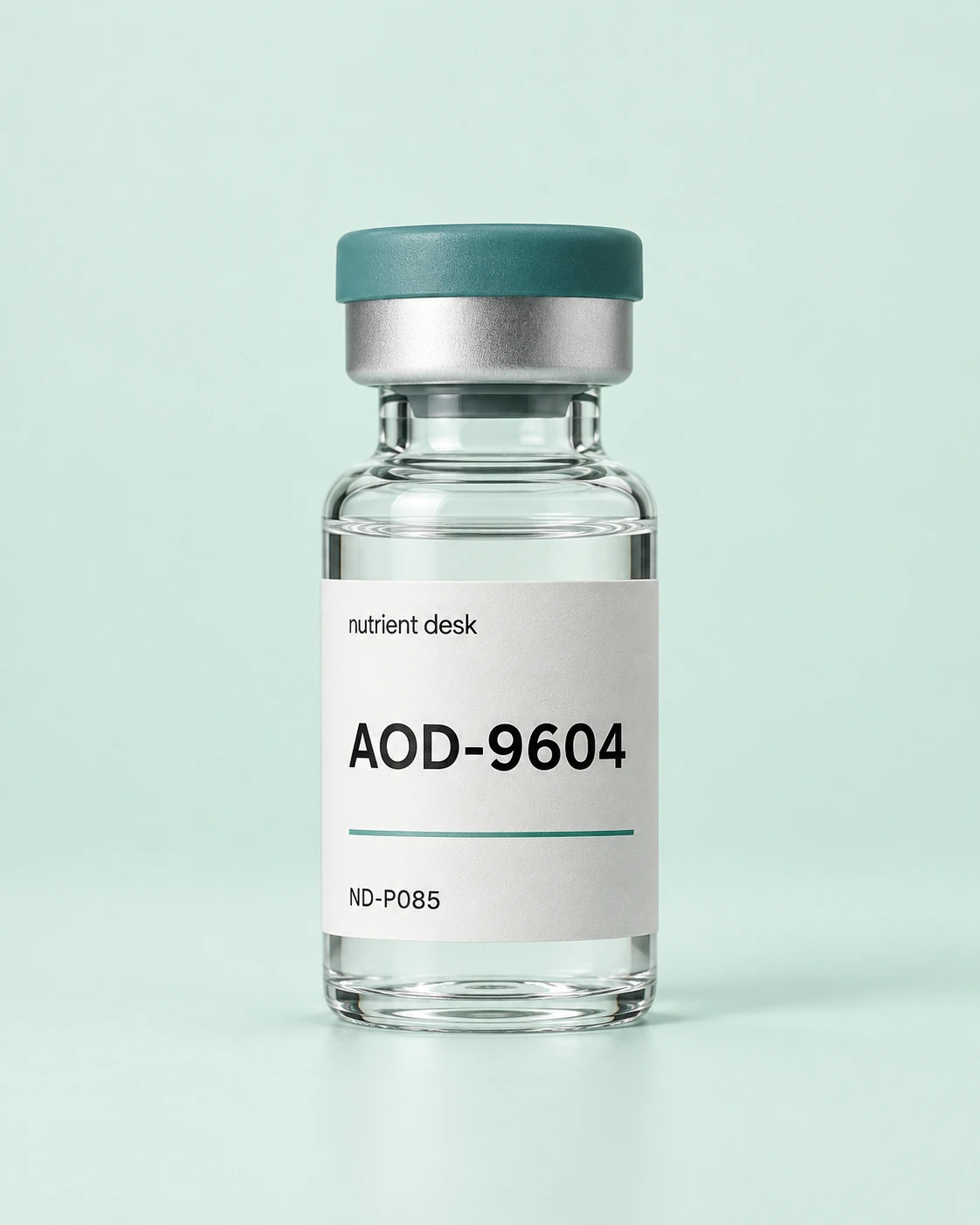
AOD-9604Experimental growth-hormone-derived fragment
AOD-9604 was developed from a region of growth hormone associated with fat metabolism. Its human development history is more informative than the recurring claim that it selectively burns fat.
What is AOD-9604?
AOD-9604 is a modified fragment derived from human growth hormone. It was developed around the idea of influencing fat metabolism without reproducing all actions of the full hormone.
How it works
The proposed separation of fat-related effects from other growth-hormone effects is a development hypothesis, not a consequence guaranteed by using a shorter sequence.
Effects studied
Weight loss
FDA advisory material describes a 24-week obesity study in which the developer reported no statistically significant weight-loss advantage at the specified endpoints. A full published account was unavailable in that assessment. 1
Evidence: An unsuccessful reported clinical result with limited publication; positive animal findings do not override it.
What made the original idea promising
In obese rats, a 19-day study found less weight gain and increased lipolytic activity with AOD-9604. A separate 14-day mouse study found less weight gain and increased fat oxidation, without the hyperglycaemia seen with full GH in that experiment. These are useful animal findings, and “less weight gain” should not be rewritten as weight loss. They help explain the development programme; they do not overturn its reported unsuccessful human obesity trial. 2 3 1
Evidence: Positive rodent results; separate negative human trial report with publication limitations.
What does the evidence show?
Preclinical rationale and regulator-reviewed development history
Separating a fragment from the full hormone
AOD-9604 is a modified peptide derived from the end of human growth hormone. The development idea was to retain effects on fat metabolism without reproducing all of growth hormone’s actions. A proposed separation of effects, however, needs to be demonstrated rather than assumed from the molecule’s shorter length.
The larger human result matters
The FDA’s 2024 compounding advisory material describes a 24-week obesity study and quotes the developer’s report that weight loss versus placebo did not reach statistical significance at the specified endpoints. The briefing also notes the lack of a full published account of that study. 1
An unsuccessful trial is part of the evidence
There is a difference between a compound that has never been tested for an outcome and one whose development programme reported an unsuccessful trial. The latter deserves to be visible beside positive animal findings. Limited publication prevents a complete independent analysis; it does not turn the result into proof of benefit.
What made the original idea promising
In obese rats, a 19-day study found less weight gain and increased lipolytic activity with AOD-9604. A separate 14-day mouse study found less weight gain and increased fat oxidation, without the hyperglycaemia seen with full GH in that experiment. These are useful animal findings, and “less weight gain” should not be rewritten as weight loss. They help explain the development programme; they do not overturn its reported unsuccessful human obesity trial. 2 3 1
The route cannot be assumed
Historical oral research should not be used to validate a different injected product. Product identity, impurities and immune reactions are separate concerns from whether the mechanism is plausible. For AOD-9604, the term “growth-hormone fragment” describes the compound’s origin. It establishes neither a clinical effect nor a safe way to manage weight.
Safety & status
Historical oral research does not validate an injected preparation. Product impurities and immune reactions are separate safety issues from whether a fat-metabolism mechanism is plausible. 1
Country and product status
A 2024 FDA advisory briefing was checked as evidence review; an advisory document is not marketing authorisation.
Frequently asked questions
Was it only untested for weight loss?
No. The FDA material includes a reported study that did not meet the specified weight-loss endpoints. 1
Is AOD-9604 identical to every HGH fragment product?
No. Its modified sequence should be distinguished from products labelled with other fragment identities.
Further reading
Sources
This entry was rewritten from our research archive. References below are reading leads unless a completed check is explicitly noted; a full independent evidence and regulatory review is still pending.
- FDA (2024): AOD-9604 advisory evidence assessment Regulatory evidence review · Relevant assessment excerpt checked; underlying unpublished trial not independently inspected; checked 2026-10-29
- Ng et al. (2000): Metabolic studies of AOD9604 Primary research · PubMed abstract checked; full paper not reviewed; checked 2026-10-29
- Heffernan et al. (2001): AOD9604 and fat oxidation in obese mice Primary research · PubMed abstract checked; full paper not reviewed; checked 2026-10-29
Research provenance
This name was discovered in the Superpower peptide index, archived 26 October 2026. Its ratings and reviewer attribution have not been adopted as our own. The archive informed this original editorial draft; independent source review is still pending.