
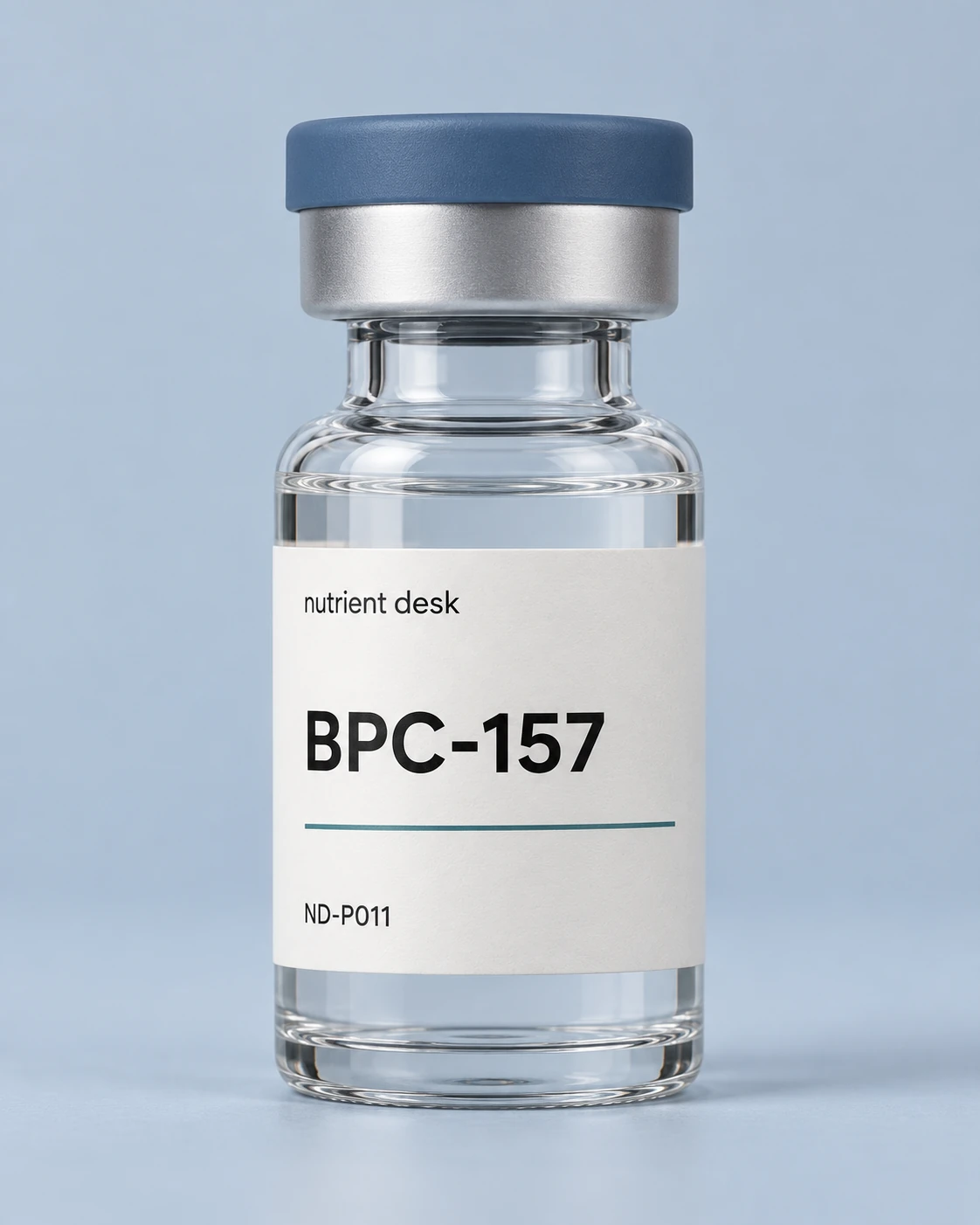
BPC-157Experimental peptide for injury repair
A synthetic peptide based on a fragment of a stomach protein. It is sold online for tendon, ligament and joint injuries, but has only been tested in people in one small report without a control group.
What is BPC-157?
BPC-157 is an experimental peptide discussed in research on injury and tissue repair. Human evidence is limited and does not establish it as a treatment for tendon or ligament injuries.
How it works
In rat tendon-cell and tissue experiments, BPC-157 increased FAK–paxillin signalling and actin-fibre formation, processes that help repair cells attach and move. This is a proposed preclinical repair mechanism, not proof that it regenerates human tendons. 3
Effects studied
14 / 16reported some relief
Knee pain
14 of 16 people reported some relief after injections, with no comparison group and mixed treatments. 1
- Lab
- Animal
- People
- Large trials
Labels: Proven = consistent results in good human trials. Mixed = results point in different directions. Not shown = tested in people without a clear effect, or only in uncontrolled reports. Lab & animal only = no human evidence yet.
What does the evidence show?
Small uncontrolled human reports; preclinical repair research
The question behind the recovery promise
When an injury interrupts training, even a small improvement can feel important. But less pain, repaired tissue and readiness to compete are different outcomes. A useful BPC-157 study would need to tell us which one changed, how much it changed and what happened without treatment.
The human report examined here can guide those questions, but cannot reliably predict the outcome for another injured person.
What the knee-pain report measured
In a 2021 retrospective report, investigators contacted 16 people after treatment: 12 had received BPC-157 alone and four had also received thymosin beta-4. Fourteen reported some pain relief across those groups. Follow-up varied, and the study had no placebo group or standardised outcome questionnaire. 1
That makes the result interesting but difficult to interpret. Pain can change alongside rehabilitation, activity and time. This design cannot separate those influences from a treatment effect, and it did not establish faster tendon or ligament repair. The 14-of-16 figure is not a success rate that can be offered to a new patient.
What would make the answer more useful?
A controlled trial would compare the same injury and rehabilitation programme, then measure outcomes people care about: function, time away from sport, repeat injury and adverse effects. Such a comparison can establish whether a promising treatment helps in a way that a before-and-after account cannot.
The sources checked for this profile do not amount to a comprehensive, up-to-date systematic review. The conclusion is about the evidence examined here; it does not assume that an unproven benefit is impossible.
Why tendon repair is being investigated
In rat tendon tissue and cultured tendon cells, BPC-157 promoted cell migration and tissue outgrowth, with changes in FAK–paxillin signalling. It did not directly increase cell proliferation in the reported assay. These findings give the repair hypothesis a biological basis; whether they translate into stronger or faster-healing human tendons remains a clinical question. 3
Other early human reports
A 2024 uncontrolled pilot in 12 women with interstitial cystitis reported symptom improvement after bladder injections: 10 described complete and 2 partial improvement. These are patient-reported experiences in a small, selected clinic group, not proof of efficacy or evidence about sports injuries. A separate 2025 intravenous safety report followed only 2 adults who had previously received BPC-157. No adverse effects were reported during the brief observation. That cannot establish long-term safety or detect uncommon harms. 4 5
Product identity and safety
The FDA flags immune-reaction and impurity concerns for compounded BPC-157 and describes limited safety information. Its current page places this substance among withdrawn compounding nominations; withdrawal is not approval. 2
A product described as a research chemical does not resolve the questions about its identity, quality or clinical use. This profile therefore links to evidence rather than to sellers or treatment protocols.
Safety & status
Side effects & safety
Little safety information in people. The FDA warns of possible immune reactions and impurities in compounded peptide. 2
Not approved. The FDA lists it among compounding substances with significant safety risks. 2
No marketing authorisation as a medicine found in this review.
The FDA identifies concerns about immune reactions and peptide impurities, with limited safety information. A withdrawn compounding nomination does not constitute approval. 2
Frequently asked questions
Does pain relief mean an injury healed?
No. Pain and tissue healing are different outcomes; this report did not establish structural repair. 1
Was BPC-157 tested against placebo?
Not in the knee-pain report described here. The absence of a comparison group limits what its results can show. 1
Further reading

Sources
This entry was rewritten from our research archive. References below are reading leads unless a completed check is explicitly noted; a full independent evidence and regulatory review is still pending.
- Lee & Padgett · Intra-articular BPC-157 and knee pain (2021) Primary human report · PubMed abstract checked; no controlled comparison.; rechecked 2026-10-29
- FDA · Compounding substances with potential significant safety risks US regulator · Current page checked; withdrawn-nominations section. Not an EU or Swiss ruling.; rechecked 2026-10-29
- Chang et al. · BPC-157, tendon outgrowth, cell survival and migration (2011) Primary preclinical study · Indexed PubMed abstract checked; rat Achilles tendon explants and cultured tendon fibroblasts. Increased FAK/paxillin phosphorylation and cell migration; no direct increase in fibroblast proliferation.; rechecked 2026-10-29
- Lee et al. (2024): BPC-157 for interstitial cystitis Uncontrolled human pilot · PubMed abstract checked; full paper not reviewed; checked 2026-10-29
- Lee & Burgess (2025): Intravenous BPC-157 safety pilot Two-person safety observation · PubMed abstract checked; full paper not reviewed; checked 2026-10-29
Related names & questions
Connections help distinguish compounds and uses; they do not imply equivalent benefits.
Research provenance
This name was discovered in the Superpower peptide index, archived 26 October 2026. Its ratings and reviewer attribution have not been adopted as our own. The archive informed this original editorial draft; independent source review is still pending.