
BrilacidinRelated non-peptide compound
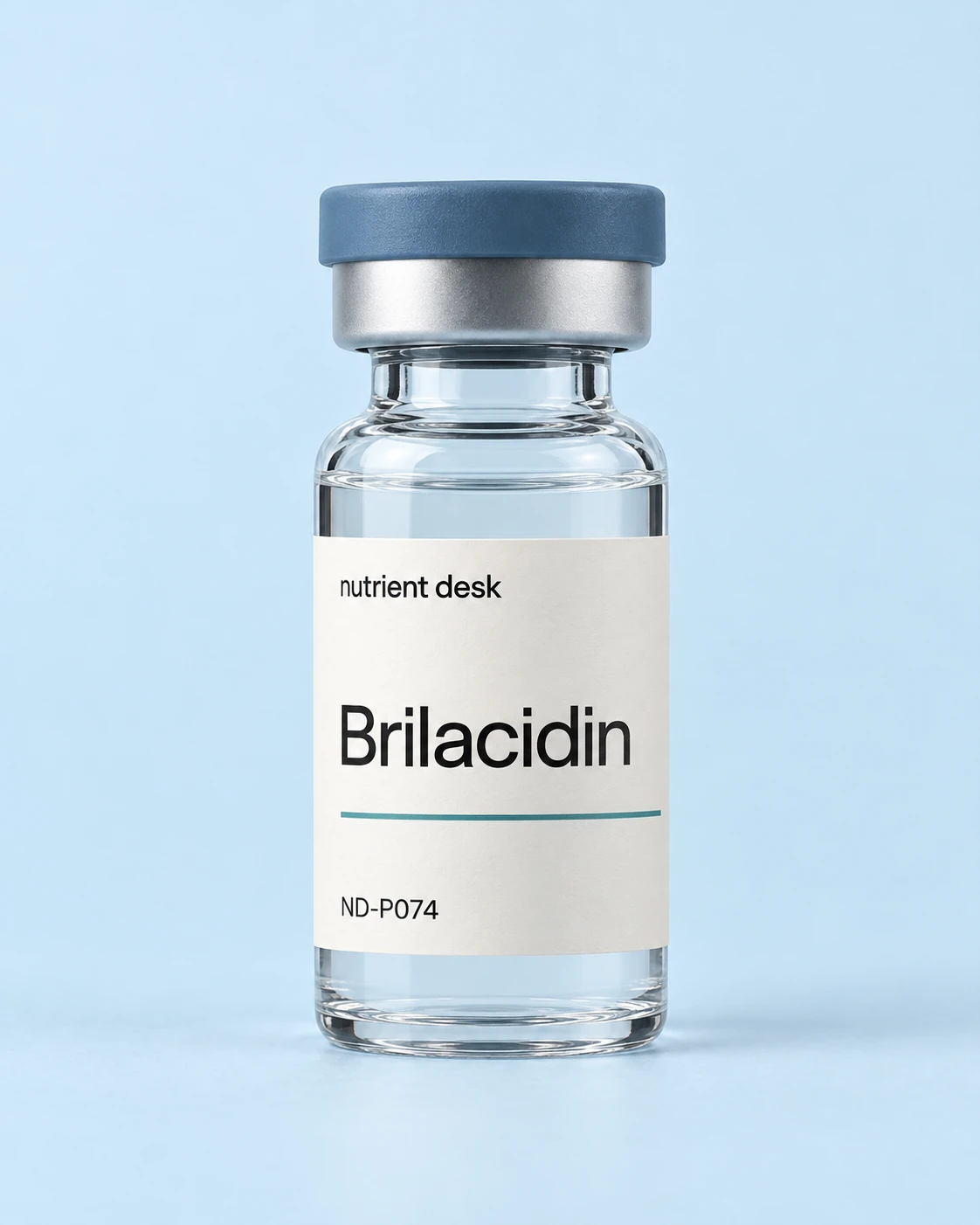
Brilacidin is a small molecule designed to imitate aspects of antimicrobial peptides. It is related to peptide research by its function, but it is not itself a conventional peptide.
What is Brilacidin?
Brilacidin is a non-peptide defensin mimetic. It appears in peptide research collections because it was designed to imitate aspects of antimicrobial host-defence molecules.
How it works
Its proposed antimicrobial activity draws on defensin-like interactions. Laboratory antiviral activity and treatment of inflammatory injury are separate development questions.
Effects studied
What does the evidence show?
Preclinical antimicrobial studies and condition-specific development
Borrowing an idea from innate immunity
Defensins are part of the body’s early defence against microbes. Brilacidin was designed as a non-peptide mimetic: a chemically different molecule that reproduces some relevant properties. This distinction helps avoid treating every compound appearing in a peptide catalogue as the same type of substance.
Several questions, several settings
Research has explored antibacterial activity, antiviral effects and inflammatory conditions such as oral mucositis. These programmes have different targets, routes and endpoints. An effect on a cultured virus cannot establish that the medicine improves outcomes in a hospitalised patient, or that it helps a mouth ulcer.
What the laboratory evidence contributes
The retained papers describe antiviral experiments, including work involving SARS-CoV-2. Such studies can help identify concentrations and mechanisms worth investigating. They do not establish that effective concentrations can be reached safely in the relevant human tissue, which is one reason clinical trials remain essential.
Keep claims attached to the formulation
Systemic administration and local treatment expose the body differently. Safety findings from one setting should not be used to declare another route safe. Each proposed use of brilacidin needs its own assessment. Company development announcements do not establish clinical benefit or current regulatory approval.
Safety & status
Tolerability and exposure must be evaluated for the actual formulation and route. Findings from one development setting do not provide a general safety profile.
Country and product status
Country-specific product availability and authorisation require a separate current check.
Frequently asked questions
Is brilacidin a peptide?
No. It is a non-peptide compound designed to mimic aspects of defensin activity.
Does laboratory antiviral activity mean it treats COVID-19?
No. Patient benefit requires controlled clinical evidence rather than cell-culture activity alone.
Further reading
Sources
This entry was rewritten from our research archive. References below are reading leads unless a completed check is explicitly noted; a full independent evidence and regulatory review is still pending.
- Brilacidin · retained archive reference Archive research lead · Retained archive reference; not independently checked for this draft
- Brilacidin · retained archive reference Archive research lead · Retained archive reference; not independently checked for this draft
Research provenance
This name was discovered in the Superpower peptide index, archived 26 October 2026. Its ratings and reviewer attribution have not been adopted as our own. The archive informed this original editorial draft; independent source review is still pending.