
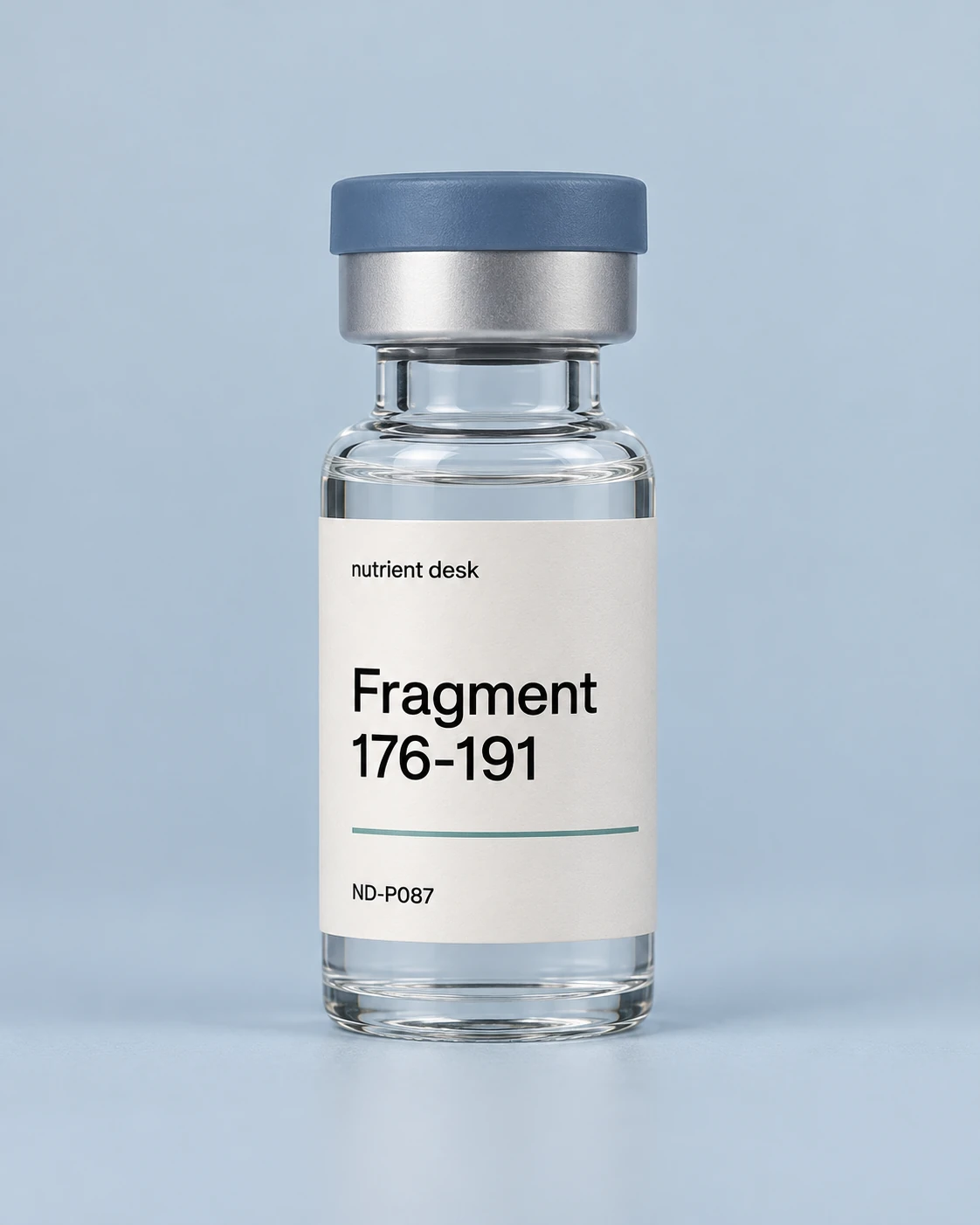
Fragment 176-191Experimental growth hormone fragment
The name refers to a short region of human growth hormone. Research on this region explores fat metabolism, but closely related fragments and modified analogues must be kept distinct.
What is Fragment 176-191?
Fragment 176–191 refers to a portion of the human growth-hormone sequence. It is distinct from full-length growth hormone and from modified related fragments such as AOD-9604.
How it works
Experimental work explores how portions of growth hormone affect fat handling. A fragment cannot be assumed to reproduce the full hormone’s effects on growth or IGF-1 signalling.
Effects studied
What the older experiments actually tested
The 1993 paper tested fragment 177–191 in rat fat tissue, not the identically named 176–191 product. It reduced fat synthesis but did not significantly increase glycerol release, the study’s measure of fat breakdown. That is an interesting metabolic finding, with a narrower meaning than “fat burning”. The other cited paper studied modified AOD-9604. Both provide context for the research idea; neither directly demonstrates weight loss from a 176–191 preparation in people. 1 2
Evidence: Related-sequence animal/tissue research; identity and endpoint limitations.
What does the evidence show?
Historical preclinical fragment research
What the numbers describe
The numbers 176–191 identify positions within the larger human growth hormone sequence. A fragment contains only that part of the molecule. It therefore should not be assumed to reproduce the full hormone’s effects on growth, IGF-1 signalling, metabolism or adverse reactions.
The identity problem in online claims
AOD-9604 is a modified related fragment, not a synonym for every product labelled “HGH fragment”. Historical studies may also examine a sequence with a slightly different starting position. Marketing that groups these compounds together for fat loss can obscure those differences.
What the older experiments actually tested
The 1993 paper tested fragment 177–191 in rat fat tissue, not the identically named 176–191 product. It reduced fat synthesis but did not significantly increase glycerol release, the study’s measure of fat breakdown. That is an interesting metabolic finding, with a narrower meaning than “fat burning”. The other cited paper studied modified AOD-9604. Both provide context for the research idea; neither directly demonstrates weight loss from a 176–191 preparation in people. 1 2
What a clinical trial would need to specify
A useful clinical study would specify the sequence, formulation, route and actual patient outcome. It would also need a comparison group and sufficient follow-up. Until those details are available, the most accurate account is an experimental fragment with a biological rationale. Neither the established medical uses of full-length growth hormone nor the separate AOD-9604 development programme can fill that evidence gap by association.
Safety & status
Exact sequence, formulation and route matter. Neither medical experience with full-length growth hormone nor a separate fragment’s programme establishes this product’s human safety.
Country and product status
Country-specific product availability and authorisation require a separate current check.
Frequently asked questions
What do 176–191 mean?
They identify amino-acid positions within the larger growth-hormone sequence.
Can AOD-9604 results be assigned to this fragment?
Not automatically. AOD-9604 is modified, and related fragments may have different sequences and preparations.
Further reading
Sources
This entry was rewritten from our research archive. References below are reading leads unless a completed check is explicitly noted; a full independent evidence and regulatory review is still pending.
- Wu & Ng (1993): Antilipogenic activity of hGH fragment 177–191 Primary research · PubMed abstract checked; full paper not reviewed; checked 2026-10-29
- Ng et al. (2000): Metabolic studies of the modified fragment AOD9604 Primary research · PubMed abstract checked; full paper not reviewed; checked 2026-10-29
Research provenance
This name was discovered in the Superpower peptide index, archived 26 October 2026. Its ratings and reviewer attribution have not been adopted as our own. The archive informed this original editorial draft; independent source review is still pending.