
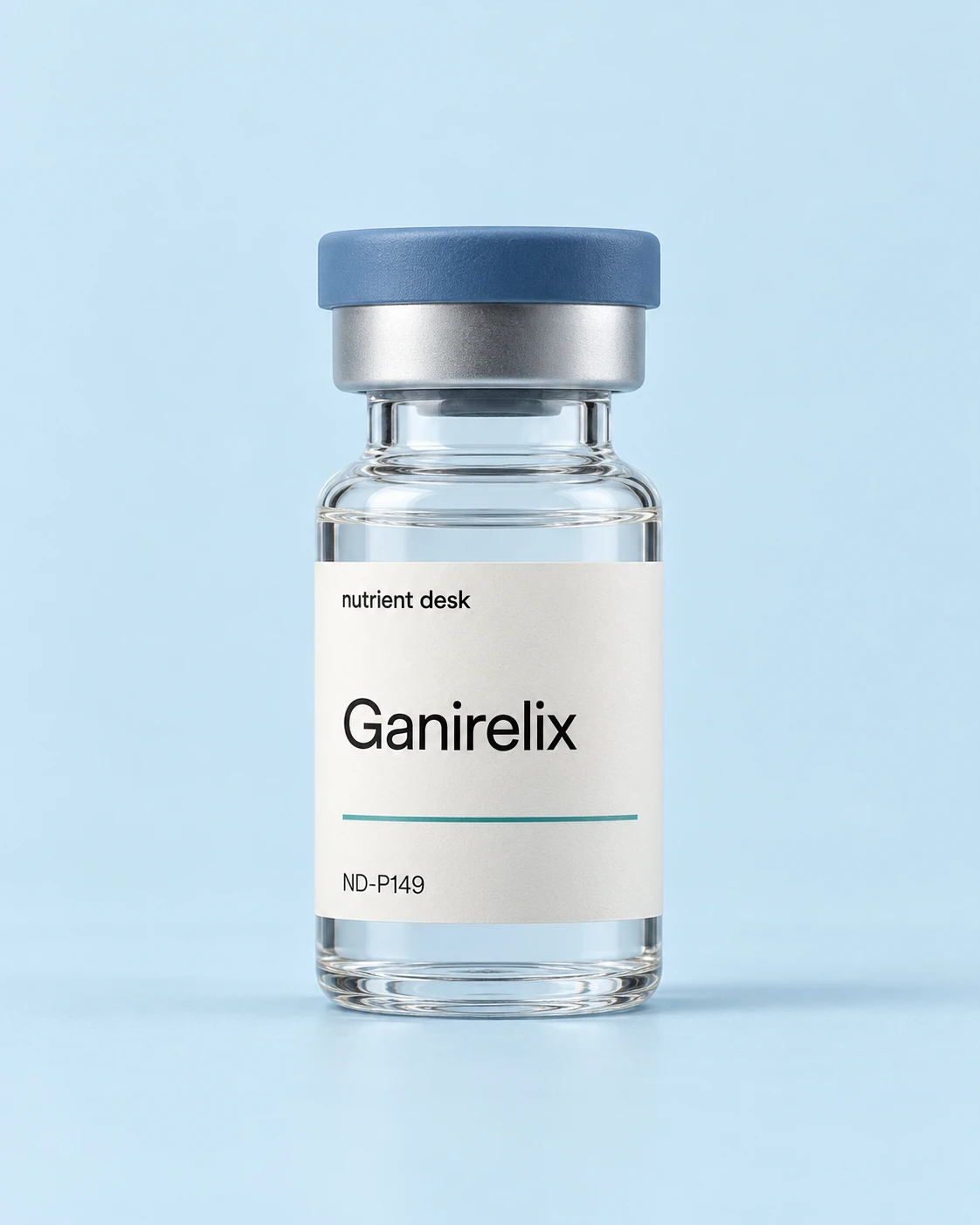
GanirelixGnRH antagonist
Ganirelix helps prevent a premature hormone surge during ovarian stimulation. Its purpose is to keep the timing of egg collection under control, while other medicines drive follicle development.
What is Ganirelix?
Ganirelix is a GnRH receptor antagonist used during ovarian stimulation for assisted reproduction. Its role is to prevent a premature luteinising hormone surge and ovulation while other medicines support follicle development. 1 3
How it works
It temporarily blocks pituitary GnRH receptors, suppressing the LH signal that could trigger ovulation before the planned stage of treatment. 2 3
Effects studied
What does the evidence show?
Ovarian-stimulation trials and EMA assessment
Timing is part of the treatment
During assisted reproduction, several follicles may be stimulated to develop together. An early luteinising-hormone surge could trigger ovulation before the planned collection. Ganirelix blocks the pituitary GnRH receptor to reduce that risk, rather than acting as the medicine that makes follicles grow.
Why an antagonist is useful here
A receptor antagonist can suppress the relevant hormone signal without the initial stimulation associated with a GnRH agonist. The practical benefit is control within a defined fertility protocol. That does not make ganirelix a general treatment for low fertility, irregular cycles or hormone “balance”.
How to interpret the comparisons
The EMA assessment describes studies comparing ganirelix-based protocols with GnRH-agonist approaches. Egg yield and pregnancy are related but separate outcomes, and results depend on the complete stimulation programme and participant characteristics. Better control of timing does not establish a higher live-birth rate. 3
Side effects and monitoring during stimulation
Injection-site redness and swelling are common tolerability issues. Hypersensitivity and the risks of the overall ovarian-stimulation process also require attention. The EU Orgalutran indication concerns prevention of premature ovulation during stimulation; the treating fertility team manages the connected steps, monitoring and timing. 3
Safety & status
Injection-site redness or swelling and hypersensitivity can occur. Risks of the overall stimulation programme, including ovarian hyperstimulation syndrome, must be assessed separately from the antagonist alone. 2 3
Country and product status
EU Orgalutran indication checked for preventing premature ovulation during ovarian stimulation. Swiss status not checked.
Frequently asked questions
Does ganirelix make the follicles grow?
Its main role is preventing a premature hormonal surge; other medicines provide the stimulation for follicle development. 3
Does successful hormone suppression guarantee pregnancy?
No. Hormone control is one part of a multi-stage fertility treatment, and pregnancy and live birth are separate outcomes. 1
Further reading
Sources
This entry was rewritten from our research archive. References below are reading leads unless a completed check is explicitly noted; a full independent evidence and regulatory review is still pending.
- Retained paper reference Archive research lead · Retained archive reference; not independently checked for this draft
- Retained source reference Archive research lead · Retained archive reference; not independently checked for this draft
- EMA · Orgalutran assessment Primary source checked · Checked 27 October 2026: indication, receptor action, comparative fertility-study context and common safety information.
Research provenance
This name was discovered in the Superpower peptide index, archived 26 October 2026. Its ratings and reviewer attribution have not been adopted as our own. The archive informed this original editorial draft; independent source review is still pending.