
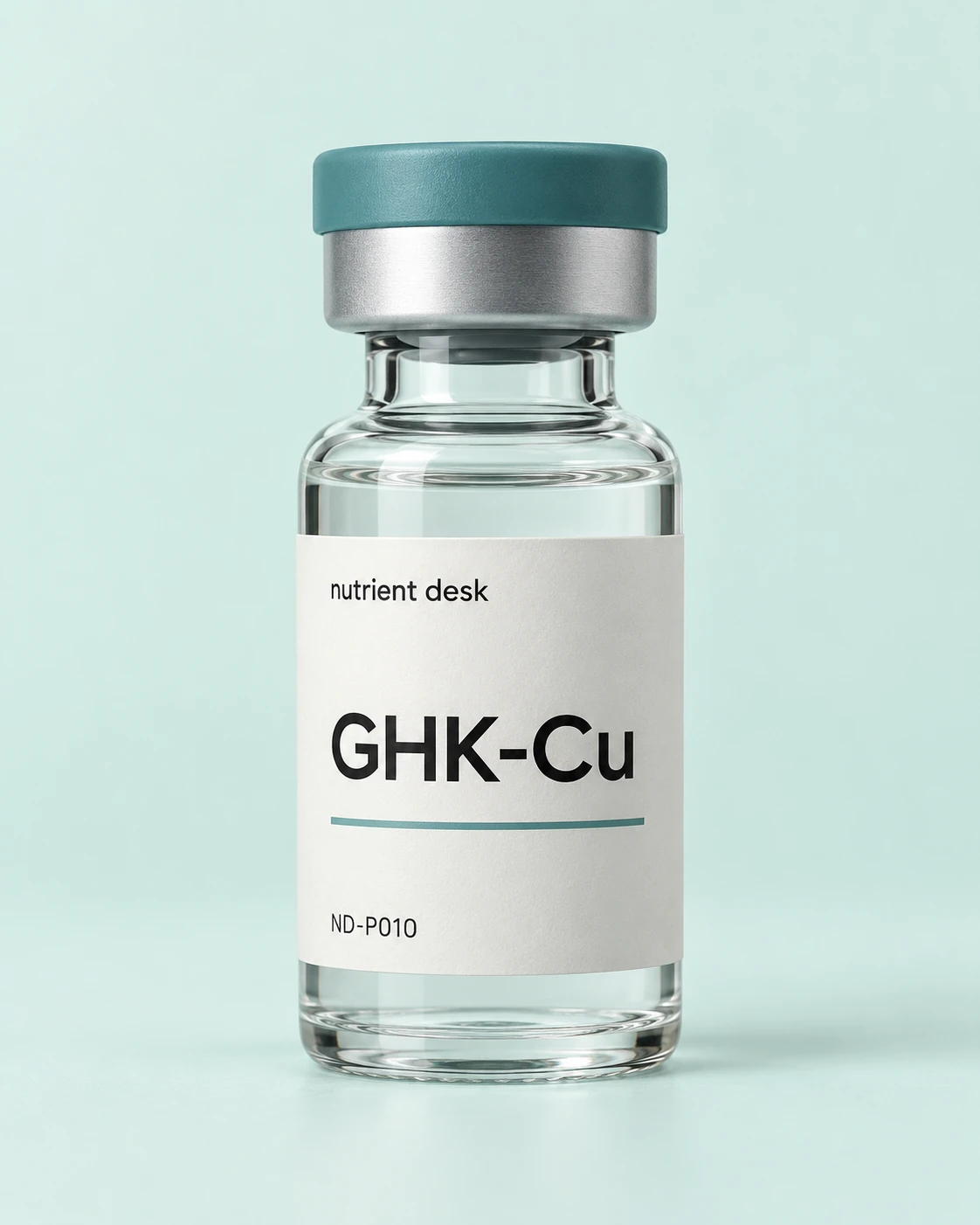
GHK-CuCopper peptide used in skin care
A tiny peptide that carries copper, added to serums and creams for skin repair and anti-ageing. Injectable versions sold online are a separate, untested question.
What is GHK-Cu?
GHK-Cu is a copper-binding tripeptide used in topical skin-care products and investigated in skin-repair research. Topical products and injected preparations require separate assessment.
How it works
In cultured human fibroblasts, GHK-Cu increased production of certain glycosaminoglycans, including dermatan and heparan sulfate—components of the material surrounding cells. This offers a laboratory explanation for repair-related effects, but does not establish skin rejuvenation or injectable benefit in people. 3
Effects studied
Skin quality after laser treatment
People rated their skin better (p = 0.04), but blinded measurements showed no difference. 1
- Lab
- Animal
- People
- Large trials
Wrinkles
No significant improvement in the objective wrinkle assessment of the same trial. 1
- Lab
- Animal
- People
- Large trials
Building skin matrix
Increased components of the material around skin cells in a dish. 3
- Lab
- Animal
- People
- Large trials
Labels: Proven = consistent results in good human trials. Mixed = results point in different directions. Not shown = tested in people without a clear effect, or only in uncontrolled reports. Lab & animal only = no human evidence yet.
What does the evidence show?
Small topical randomised trial
A skin-care ingredient is not one universal treatment
The same ingredient name can appear beside very different promises. A serum used on the skin and an injectable preparation do not share the same evidence simply because both mention GHK-Cu. To judge a claim, start with the product's route and the outcome being promised.
A useful question is narrower than whether copper peptides are good for skin: compared with what, in which people, and measured how?
What happened in a small controlled study
In a 2006 randomised study, 13 people completed skin-care regimens with or without a copper tripeptide complex after CO₂ laser resurfacing. Participants' own ratings of skin quality favoured the copper-peptide regimen (p = 0.04). Blinded or computer-assisted assessments did not show significant between-group advantages in redness resolution or the reported objective wrinkle and skin-quality measures. 1
The subjective and objective findings answer different questions. People can notice an improvement that a particular measurement misses; a small trial can also produce an unstable finding. Neither the positive questionnaire nor the negative objective results, on their own, settle how well a different serum will work.
How to read the next product claim
Look for evidence on the finished formula, the condition of the skin and the comparison group. Recovery after a laser procedure is a particular setting. It does not establish that the product reverses ageing in healthy skin.
These limited findings call for caution about cosmetic claims. They do not establish that every copper-peptide product is ineffective. Larger, well-controlled trials with clearly defined outcomes would make the answer more useful.
Why injections need a separate answer
For injectable GHK-Cu, the FDA highlights limited human safety data and potential immune reactions associated with aggregation and peptide impurities. This appears among withdrawn compounding nominations. 2
The topical trial above provides no evidence for injectable use. This profile does not treat a cosmetic ingredient listing as medicinal approval in Germany, Switzerland or the United States.
Safety & status
Side effects & safety
Results from skin products say nothing about injections. For injected GHK-Cu, the FDA notes little human safety data and a risk of immune reactions to impurities. 2
Sold in skin-care products. The FDA lists injectable GHK-Cu among compounding substances with significant safety risks. 2
Used in cosmetics. Not authorised as a medicine; a cosmetic listing is not a medical approval.
Results from topical use do not establish injection safety. The FDA highlights limited injectable safety information and possible immune reactions associated with aggregation and impurities. 2
Frequently asked questions
Has it been shown to reduce wrinkles?
The small post-laser trial did not find a significant advantage in its objective wrinkle assessment. It cannot settle every cosmetic use. 1
Can topical evidence support GHK-Cu injections?
No. Injection changes exposure and introduces safety questions that a topical trial does not answer. 2
Further reading
Sources
The checks completed for this entry are described below, including abstract-only checks. This is not a systematic review or complete prescribing information.
- Miller et al. · Topical copper tripeptide after CO₂ laser resurfacing (2006) Primary randomised trial · PubMed abstract checked; 13 completers, topical regimen and post-procedure setting.
- FDA · GHK-Cu for injectable routes US regulator · Current safety notice checked; does not assess ordinary topical cosmetic efficacy.
- Wegrowski et al. · GHK-Cu and sulfated glycosaminoglycan synthesis (1992) Primary cell-culture study · PubMed abstract checked; normal human fibroblasts in culture. Dermatan/heparan sulfate findings; no effect on hyaluronic-acid synthesis.
Related names & questions
Connections help distinguish compounds and uses; they do not imply equivalent benefits.
Research provenance
This name was discovered in the Superpower peptide index, archived 26 October 2026. Its ratings and reviewer attribution have not been adopted as our own. The introduction above is independently written using the listed sources.