
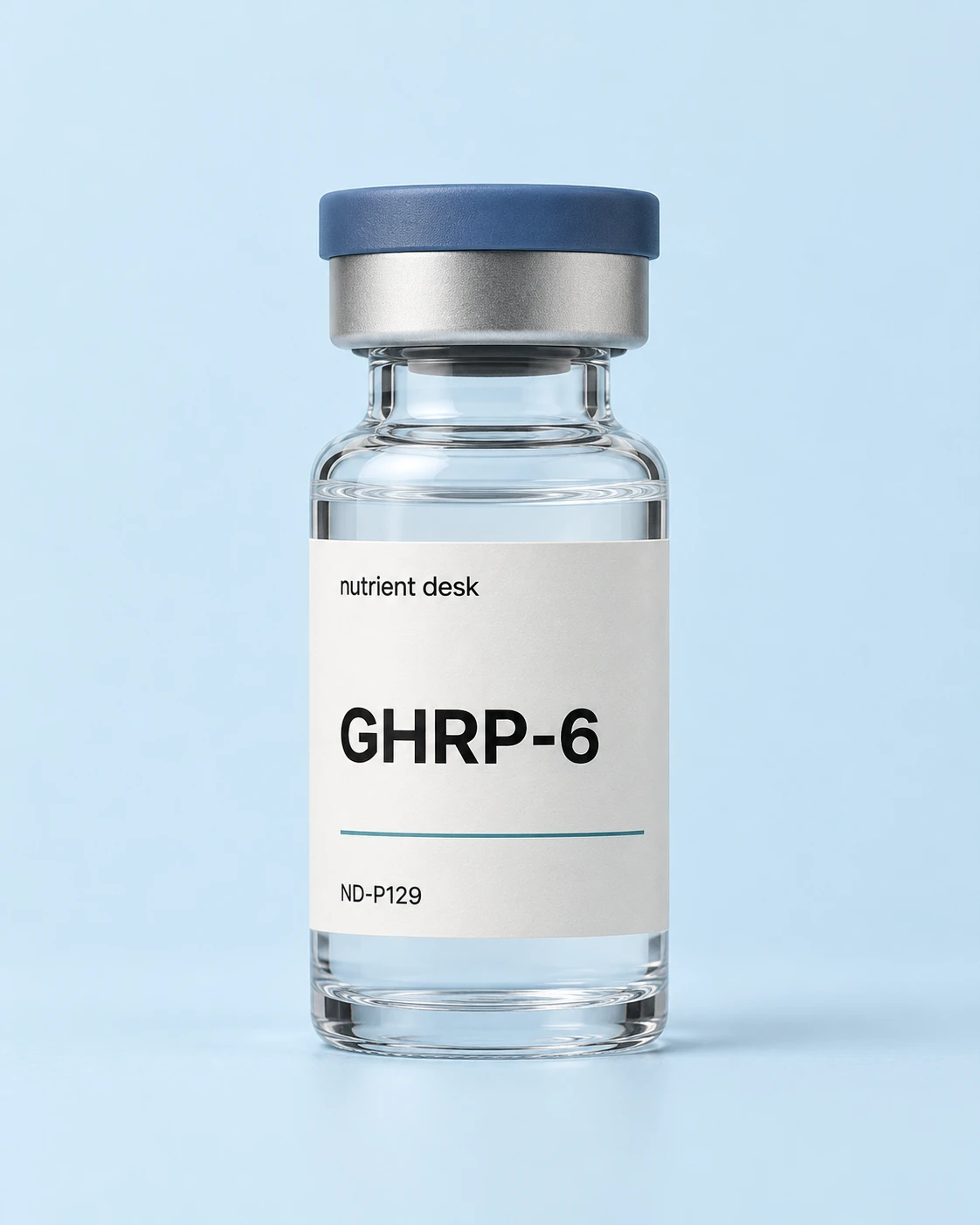
GHRP-6Ghrelin-receptor agonist · research
GHRP-6 has measurable short-term effects on GH secretion in people. Animal work also explores appetite and fat metabolism. These findings explain the interest, while leaving durable strength and recovery benefits unresolved.
What is GHRP-6?
GHRP-6 is a synthetic growth-hormone-releasing peptide from an early generation of growth hormone secretagogues. It is discussed in both endocrine research and performance marketing.
How it works
It activates the ghrelin receptor, a pathway involved in hunger and growth-hormone release. Its effects are therefore broader than the name “GH releasing” suggests.
Effects studied
Human hormone findings and animal appetite findings
A 1993 experiment in 9 healthy young men found that a 34-hour GHRP-6 infusion increased integrated GH secretion, pulse amplitude and IGF-1; pulse frequency did not increase. This demonstrates endocrine activity, without measuring lasting muscle or recovery benefits. A separate rat experiment found appetite and fat-related effects that depended partly on glucocorticoid conditions. Those animal findings cannot substitute for a human appetite trial, and the GHRP-2 appetite studies concern a different molecule. 1 2
Evidence: Small human hormone study; separate animal appetite experiment.
What does the evidence show?
Early endocrine and mechanistic research
A signal that reaches beyond growth hormone
GHRP-6 is one of the early synthetic growth hormone-releasing peptides. It activates the ghrelin receptor, a system involved in hunger as well as hormone release. Its name can make the effect sound narrowly targeted, even though the biological response is broader.
Why appetite is not a muscle outcome
Eating more may change body weight, but that does not tell us how much useful muscle was gained or whether physical performance improved. Trials would need to measure those outcomes directly and account for food intake, training and other treatments. A rise in growth hormone does not measure those outcomes.
Human hormone findings and animal appetite findings
A 1993 experiment in 9 healthy young men found that a 34-hour GHRP-6 infusion increased integrated GH secretion, pulse amplitude and IGF-1; pulse frequency did not increase. This demonstrates endocrine activity, without measuring lasting muscle or recovery benefits. A separate rat experiment found appetite and fat-related effects that depended partly on glucocorticoid conditions. Those animal findings cannot substitute for a human appetite trial, and the GHRP-2 appetite studies concern a different molecule. 1 2
Glucose and other safety questions
FDA identifies limited safety information and concerns about cortisol and increased blood glucose through reduced insulin sensitivity. It also flags potential immune reactions related to aggregation and peptide impurities. These concerns need to sit alongside the hormone findings, rather than being treated as settled by a short experiment. 3
What the longer-term question involves
Glucose control, fluid retention and stimulation of other hormones matter when exposure is repeated. Product identity and purity add another layer for research preparations. Trials need to show both a meaningful functional gain and tolerable risks in the same population. Separate favourable laboratory findings cannot establish that balance.
Safety & status
Glucose regulation, fluid retention and other hormonal responses matter with repeated use. Unverified research preparations add uncertainty about identity and purity.
FDA identifies limited safety information and concerns about cortisol and increased blood glucose through reduced insulin sensitivity. It also flags potential immune reactions related to aggregation and peptide impurities. These concerns need to sit alongside the hormone findings, rather than being treated as settled by a short experiment. 3
Country and product status
Product indications and availability vary by country; current EU and Swiss status has not been independently checked for this draft.
Frequently asked questions
Does increased appetite prove muscle growth?
No. Eating more can change body weight without demonstrating functional muscle gain.
Is it interchangeable with GHRP-2?
No. They are separate compounds. Shared receptor activity does not establish matching clinical effects or risks.
Further reading
Sources
This entry was rewritten from our research archive. References below are reading leads unless a completed check is explicitly noted; a full independent evidence and regulatory review is still pending.
- 1993: Prolonged GHRP infusion and pulsatile GH secretion in normal men Primary research · PubMed abstract checked; full paper not reviewed; checked 2026-10-29
- 2004: Glucocorticoid-dependent stimulation of adiposity and appetite by a ghrelin mimetic in the rat Primary research · PubMed abstract checked; full paper not reviewed; checked 2026-10-29
- FDA: Compounding substances with potential significant safety risks US regulator · Relevant compound entries checked; not an EU/Swiss authorisation assessment; checked 2026-10-29
Research provenance
This name was discovered in the Superpower peptide index, archived 26 October 2026. Its ratings and reviewer attribution have not been adopted as our own. The archive informed this original editorial draft; independent source review is still pending.