
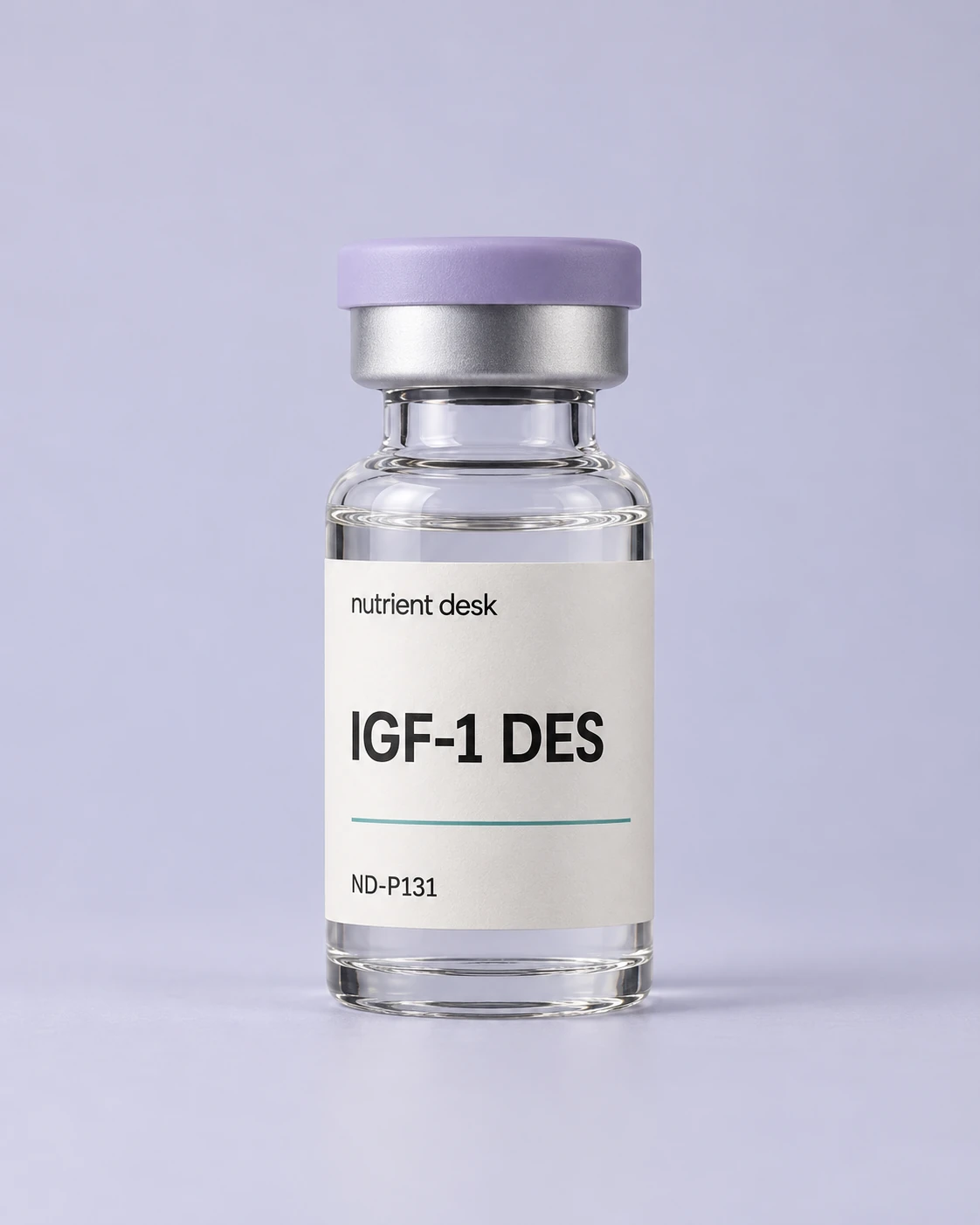
IGF-1 DESModified IGF-1 · laboratory research
IGF-1 DES is a shortened form of insulin-like growth factor 1. It is used in research on growth signalling, but a strong cellular response does not establish a safe or effective bodybuilding treatment.
What is IGF-1 DES?
IGF-1 DES is a shortened form of insulin-like growth factor 1 used in experimental research. It lacks the first three amino acids of the native growth factor.
How it works
The shortened sequence changes interaction with IGF-binding proteins, which help regulate the growth factor’s distribution and availability.
Effects studied
What does the evidence show?
Biochemical and animal research
What has been changed
The DES form lacks the first three amino acids of IGF-1. This changes its interaction with IGF-binding proteins, which normally help regulate where the growth factor travels and how available it is. The modification changes the molecule’s behaviour; it is not simply another name for the same clinical product.
Why laboratories use it
A growth factor with different binding behaviour can help researchers study cell proliferation and signalling. The retained papers concern these biological properties and experimental responses. Effects in cultured cells or animal organs do not establish that a particular human muscle will grow safely after injection. 1 2
Why an IGF-1 medicine is not a shortcut to proof
Clinical experience with a full-length IGF-1 product concerns its own preparation, diagnosis and monitoring. It cannot answer the same questions for a modified sequence with different binding characteristics. Claims about localised growth especially require evidence about distribution and clinical outcomes, rather than an assumption that the injection stays local.
The risk is not limited to the injection site
IGF signalling affects glucose handling and cell growth in many tissues. Low blood glucose and unwanted growth effects are relevant concerns to investigate, even when their frequency for this preparation is not established. Without dependable human safety data, a short duration of action does not establish that the experimental product is harmless.
Safety & status
Effects on glucose handling and unwanted growth signalling are important concerns. Their frequency in people using this preparation is not established by the retained evidence.
Country and product status
Product indications and availability vary by country; current EU and Swiss status has not been independently checked for this draft.
Frequently asked questions
Is DES the same as a full-length IGF-1 medicine?
No. The modified sequence has different binding characteristics and requires its own clinical evidence.
Does an injection cause growth only at the injection site?
That localisation is not established. Distribution and effects in other tissues need direct investigation.
Further reading
Sources
This entry was rewritten from our research archive. References below are reading leads unless a completed check is explicitly noted; a full independent evidence and regulatory review is still pending.
- Retained paper reference Archive research lead · Retained archive reference; not independently checked for this draft
- Retained paper reference Archive research lead · Retained archive reference; not independently checked for this draft
Research provenance
This name was discovered in the Superpower peptide index, archived 26 October 2026. Its ratings and reviewer attribution have not been adopted as our own. The archive informed this original editorial draft; independent source review is still pending.