
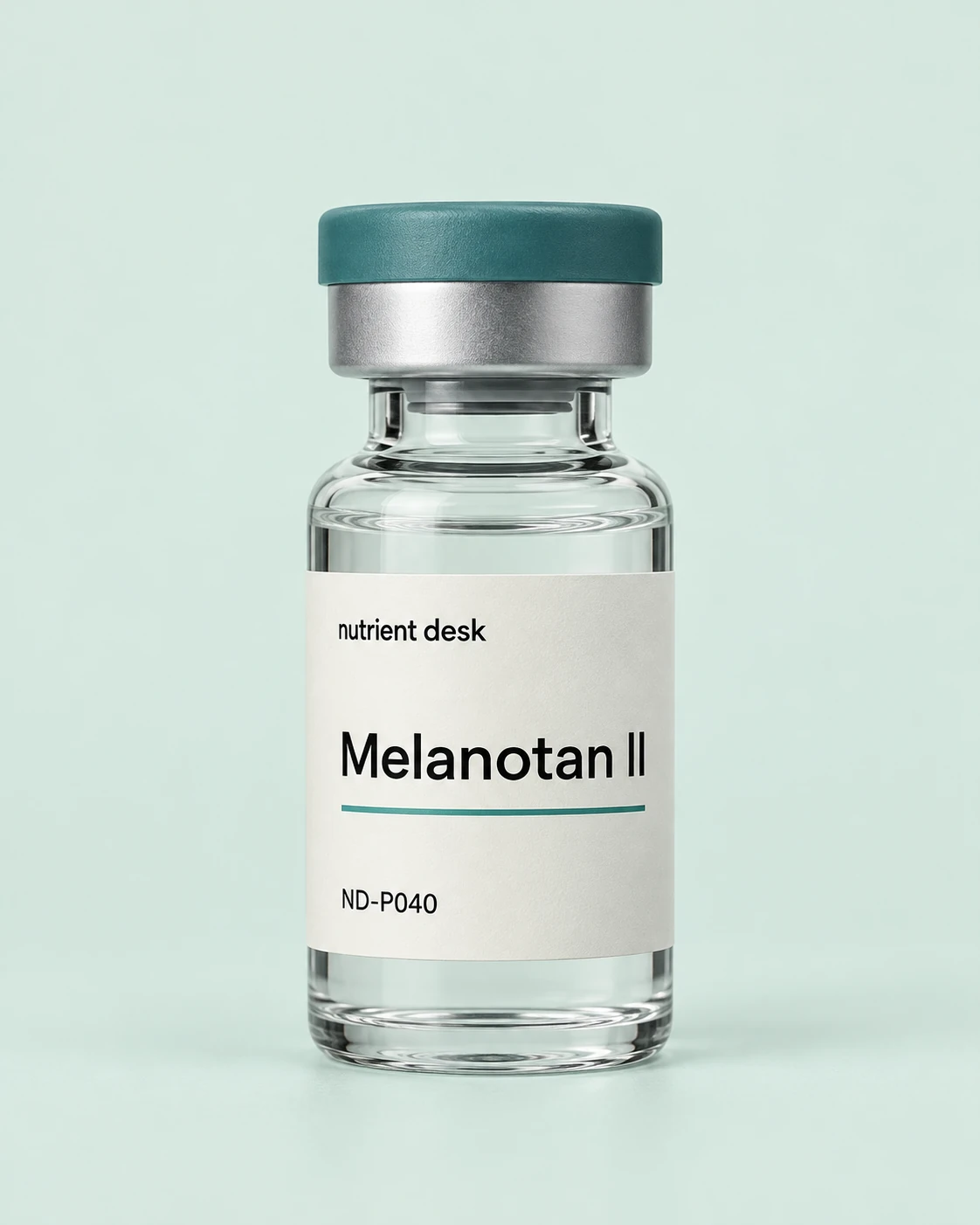
Melanotan IIExperimental melanocortin peptide
Melanotan II activates several melanocortin receptors. It is promoted for pigmentation and sexual effects, but those biological activities do not establish a safe consumer product.
What is Melanotan II?
Melanotan II is an experimental peptide that activates several melanocortin receptors. It has been investigated for pigmentation and sexual-response effects and is also marketed in unregulated tanning products.
How it works
Melanocortin signalling participates in skin pigmentation, appetite and sexual response. Activity at several receptors can produce several effects together; it does not establish a useful or safe treatment for each.
Effects studied
Skin pigmentation
Very small early human studies documented biological effects, including pigmentation. They cannot establish long-term safety or the quality of unrelated products sold online. 4
Evidence: Small early human experiments.
What does the evidence show?
The archive contains very small early human experiments and reports of pigment changes. It does not justify borrowing the evidence for regulated afamelanotide or bremelanotide products.
Why several effects can appear together
Different melanocortin receptors participate in pigmentation and other signalling, including pathways associated with appetite and sexual response. A molecule that acts at several of these receptors can produce a mixture of effects. That breadth makes its safety harder to assess.
What an early experiment can establish
Small pharmacology studies can show that a substance changes pigmentation or produces other noticeable effects. They cannot reliably estimate uncommon harms, long-term outcomes or the safety of products from unrelated suppliers. The archive’s earliest human report is useful historical context, not a consumer-use protocol. 4
How to read skin case reports
Reports of new or changing pigmented lesions raise questions that deserve attention. A case report cannot by itself prove that the peptide caused cancer, but it should not be dismissed because it lacks a placebo group. It is a different type of safety evidence. 2 3
Keep the names distinct
Melanotan II differs from Melanotan I, and neither online label guarantees equivalence to a regulated medicine. Nasal and injectable products also raise different questions about exposure. A compounding discussion or a research-use disclaimer does not establish approval or safety.
Safety & status
Reports of new or changing pigmented lesions are safety signals, although case reports alone cannot prove that the peptide caused cancer. Product identity, purity and route add further uncertainty. 2 3
Country and product status
This introduction describes the molecule and its research context. Product availability, approved indications and eligibility in Germany and Switzerland require a current local product check; they are not established by an overseas study or an online listing.
Frequently asked questions
Is Melanotan II the same as afamelanotide?
No. Evidence for an afamelanotide implant cannot be transferred to Melanotan II or to a tanning vial.
Does a tanning effect replace sun protection?
No. Darkening of the skin is not evidence that ultraviolet exposure has become safe.
Further reading
Sources
This entry was rewritten from our research archive. References below are reading leads unless a completed check is explicitly noted; a full independent evidence and regulatory review is still pending.
- Melanotan II: www.fda.gov reference Reference or product information · Retained archive reference; not independently checked for this draft.
- Melanotan II: paper 10.1001/archdermatol.2008.623 Research reference · Retained archive reference; not independently checked for this draft.
- Melanotan II: paper 10.1111/j.1365-2133.2009.09362.x Research reference · Retained archive reference; not independently checked for this draft.
- Melanotan II: pubmed.ncbi.nlm.nih.gov reference Research reference · Retained archive reference; not independently checked for this draft.
Research provenance
This name was discovered in the Superpower peptide index, archived 26 October 2026. Its ratings and reviewer attribution have not been adopted as our own. The archive informed this original editorial draft; independent source review is still pending.