
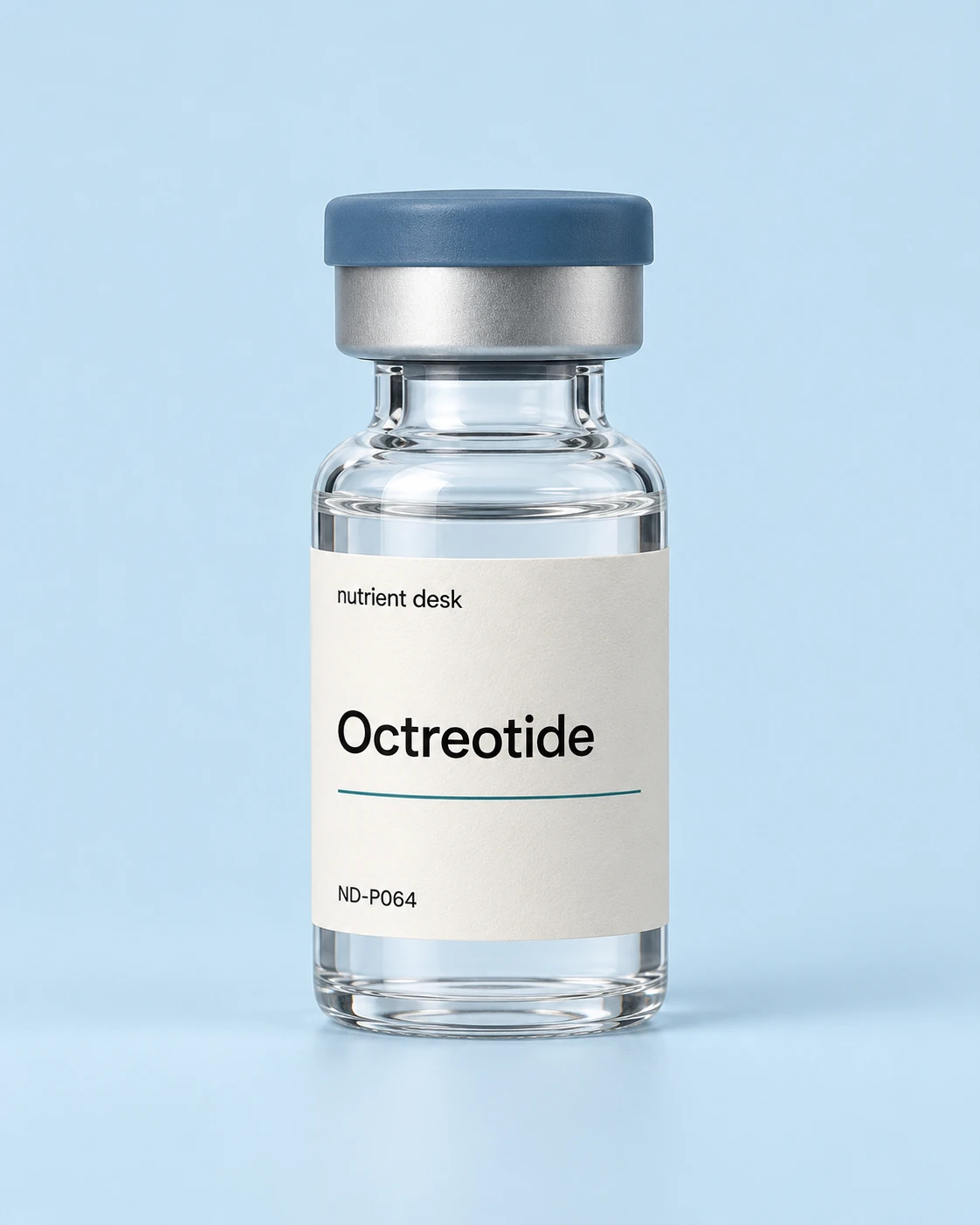
OctreotideSomatostatin analogue
Octreotide is a somatostatin analogue used in conditions involving excess hormone secretion and in selected neuroendocrine-tumour settings. It comes in formulations with different durations and uses.
What is Octreotide?
Octreotide is a somatostatin analogue used in hormone-excess conditions, including acromegaly and certain symptoms caused by neuroendocrine tumours. Short-acting injections and depot formulations have different uses and instructions. 2
How it works
It activates somatostatin receptors and inhibits the release of selected hormones. This can reduce hormone-driven symptoms without necessarily removing the underlying tumour. 2
Effects studied
Hormone-related symptoms
Used to control particular manifestations such as diarrhoea or flushing in defined neuroendocrine tumour settings, and excess growth-hormone activity in acromegaly.
Evidence: Indication-specific product information. 2
Tumour progression
PROMID investigated tumour progression in a selected population, a different question from symptom relief.
Evidence: Randomised clinical trial. 1
What does the evidence show?
The archive includes the PROMID tumour trial and product information. Its findings and indications must be matched to the tumour type and the specific formulation.
A broad signal with specific uses
Somatostatin inhibits the release of several hormones. Octreotide reproduces selected aspects of that signalling for longer than the natural hormone. This can be relevant to growth-hormone excess or to symptoms caused by hormones released from certain tumours. The underlying diagnosis determines which effect is useful.
Symptoms are not the same as tumour size
Reducing diarrhoea or flushing associated with a functional tumour can improve daily life without showing that the tumour has disappeared. A study of tumour progression asks a separate question. PROMID examined that question in a defined neuroendocrine-tumour population. 1
Formulation changes the clinical context
Short-acting injections, depot products and other presentations do not necessarily share every indication or administration rule. They should not be substituted on the basis of the molecule name alone. A research paper also cannot supply the current instructions for a different local product.
The effects of hormone suppression need monitoring
Gastrointestinal symptoms, gallbladder problems and changes in glucose regulation are important considerations. Thyroid function and heart rate may also need monitoring. These effects reflect the wider activity of the pathway being targeted and need to be weighed against the benefits of the specific product. 2
Safety & status
Gastrointestinal symptoms, gallbladder changes and altered glucose regulation can occur. Thyroid function and heart rate can also be relevant to monitoring. 2
Country and product status
This introduction describes the molecule and its research context. Product availability, approved indications and eligibility in Germany and Switzerland require a current local product check; they are not established by an overseas study or an online listing.
Frequently asked questions
Does symptom relief prove a tumour has shrunk?
No. Hormone secretion, symptoms and tumour size are separate outcomes.
Can short-acting and depot preparations be treated alike?
No. Their duration and clinical instructions differ even though they contain the same active molecule. 2
Further reading
Sources
This entry was rewritten from our research archive. References below are reading leads unless a completed check is explicitly noted; a full independent evidence and regulatory review is still pending.
- Octreotide: paper 10.1200/JCO.2009.22.8510 Research reference · Retained archive reference; not independently checked for this draft.
- Octreotide: www.novartis.com reference Reference or product information · Retained archive reference; not independently checked for this draft.
Research provenance
This name was discovered in the Superpower peptide index, archived 26 October 2026. Its ratings and reviewer attribution have not been adopted as our own. The archive informed this original editorial draft; independent source review is still pending.