
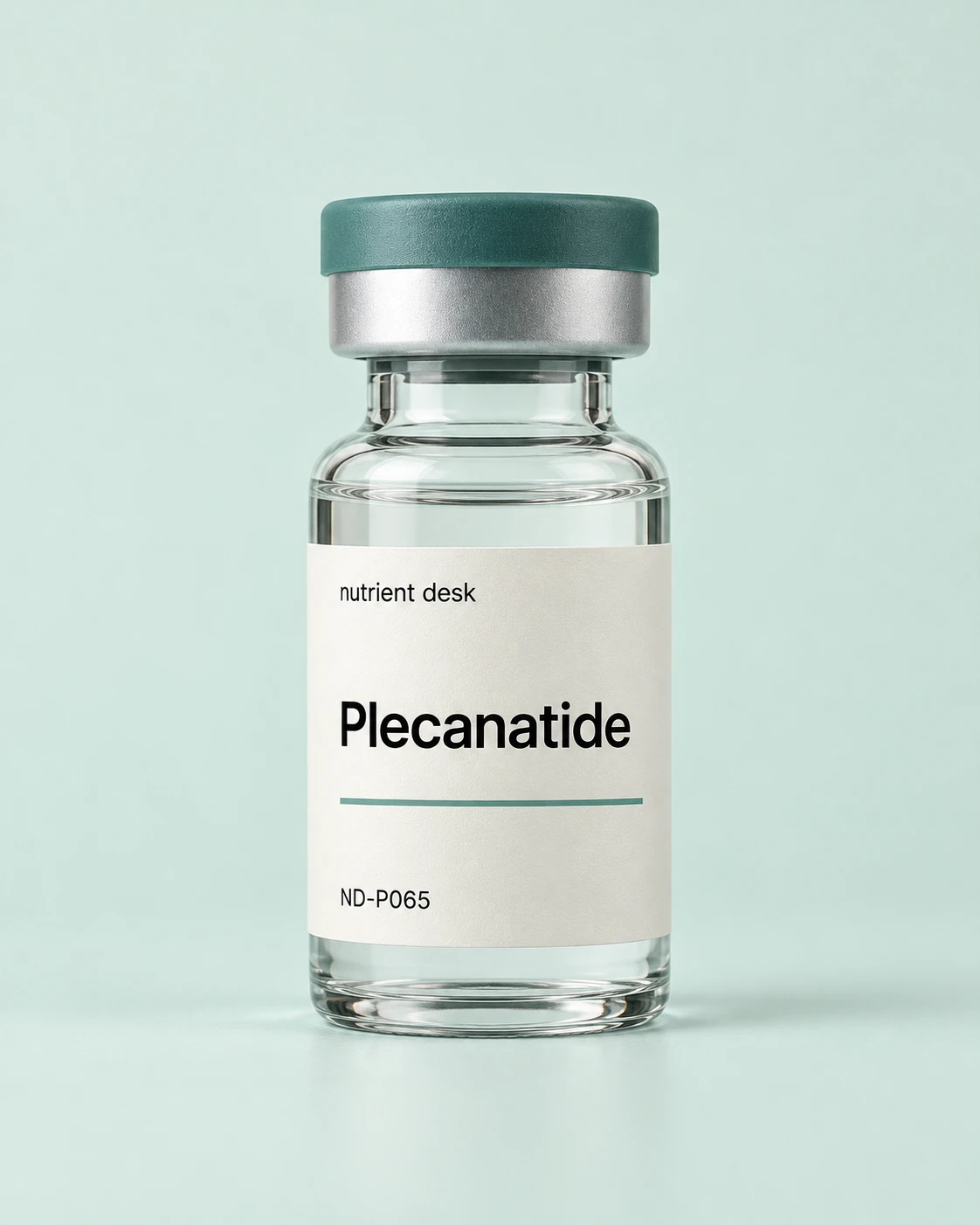
PlecanatideLocally acting intestinal peptide
Plecanatide is a peptide related to uroguanylin, a natural intestinal signal. It activates guanylate cyclase-C receptors and is used in medicines for particular constipation-related conditions.
What is Plecanatide?
Plecanatide is a uroguanylin-related peptide medicine used for defined constipation disorders, including chronic idiopathic constipation and IBS-C. These diagnoses should not be treated as interchangeable. 1 2
How it works
It activates guanylate cyclase-C in the intestine, increasing fluid secretion and supporting stool consistency and passage. Its action is predominantly local in the gut. 2
Effects studied
What does the evidence show?
The archive includes a controlled constipation trial and product information. These support a defined clinical context, while current local availability and eligibility need separate checking.
The intestinal mechanism
Guanylate cyclase-C signalling promotes the movement of fluid into the intestinal lumen. That can change stool consistency and passage. Plecanatide is intended to act mainly within the gastrointestinal tract rather than circulate widely through the body, which shapes both its potential benefit and its adverse-effect profile.
Which constipation question is being asked?
Chronic idiopathic constipation and irritable bowel syndrome with constipation overlap, but are distinct diagnoses. Bowel frequency, stool consistency and abdominal pain are also different outcomes. Each result applies to the population and outcome studied; it does not promise relief from every digestive symptom. 1
A related mechanism is not a superiority trial
Plecanatide and linaclotide both act through guanylate cyclase-C signalling. Their molecular design and pH-related behaviour differ, but those differences alone cannot show that one works better or causes fewer problems. That requires a suitable direct clinical comparison.
Where the safety context changes the decision
Diarrhoea can lead to dehydration, and suspected mechanical obstruction is a separate problem that this mechanism does not solve. Age restrictions and other eligibility details should come from current local product information. A preparation marketed online under a peptide name is not evidence of equivalence to the medicine studied in a trial. 2
Safety & status
Diarrhoea can cause dehydration. Product-specific restrictions address children and suspected or known mechanical bowel obstruction. 2
Country and product status
This introduction describes the molecule and its research context. Product availability, approved indications and eligibility in Germany and Switzerland require a current local product check; they are not established by an overseas study or an online listing.
Frequently asked questions
Is it proven better than linaclotide?
A shared receptor target does not establish superiority. That requires an appropriate direct comparison.
Is it simply a replacement for dietary fibre?
No. It is a medicine acting on intestinal secretion, with diagnosis-specific indications and safety considerations. 2
Further reading
Sources
This entry was rewritten from our research archive. References below are reading leads unless a completed check is explicitly noted; a full independent evidence and regulatory review is still pending.
- Plecanatide: paper 10.1038/ajg.2016.611 Research reference · Retained archive reference; not independently checked for this draft.
- Plecanatide: drugs.com reference Reference or product information · Retained archive reference; not independently checked for this draft.
Research provenance
This name was discovered in the Superpower peptide index, archived 26 October 2026. Its ratings and reviewer attribution have not been adopted as our own. The archive informed this original editorial draft; independent source review is still pending.