
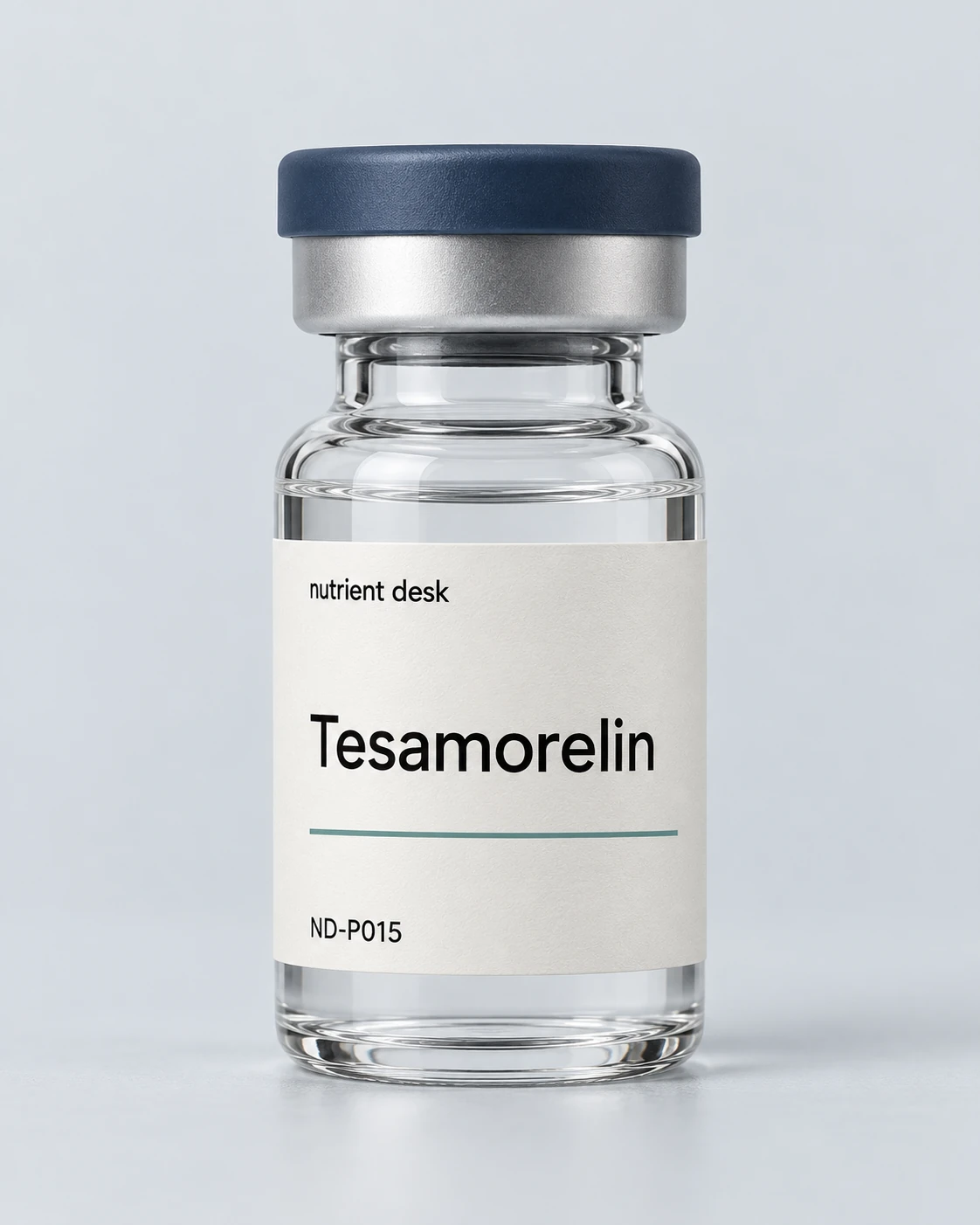
TesamorelinPrescription peptide
Tesamorelin has a specific role in excess abdominal fat associated with HIV lipodystrophy. That evidence does not establish it as a general treatment for weight loss or ageing.
What is Tesamorelin?
Tesamorelin is a growth hormone-releasing hormone analogue. The US medicinal indication concerns excess abdominal fat in adults with HIV-associated lipodystrophy, not general weight loss. 1
How it works
It stimulates pituitary growth-hormone release and downstream IGF-1 signalling, influencing fat distribution.
Effects studied
Visceral abdominal fat
The US-approved medicine reduces excess abdominal fat in adults with HIV-associated lipodystrophy. It is not indicated for weight loss, and its long-term cardiovascular safety has not been established. 1
Evidence: A specific fat-distribution outcome; long-term cardiovascular safety is not established by that result. 1
Why researchers have also studied liver fat
Liver fat is another research question. A 12-month randomised trial enrolled 61 people with HIV and non-alcoholic fatty liver disease. Tesamorelin reduced liver fat compared with placebo, providing a clinical signal in this specific population. Whether it improves long-term liver outcomes needs further study; this result does not establish a general fatty-liver indication or a benefit in otherwise healthy people. 4
Evidence: Small randomised trial in HIV-associated fatty liver disease; liver fat is not a long-term clinical outcome.
What does the evidence show?
HIV lipodystrophy trials and product-specific indication
Working upstream of growth hormone
Tesamorelin is an analogue of growth hormone-releasing hormone. It stimulates the pituitary’s growth hormone pathway, with effects on downstream signalling including IGF-1. It is different from injecting growth hormone itself, although the pathways overlap.
The population behind the evidence
The US indication concerns excess abdominal fat in adults with HIV-associated lipodystrophy, a particular disorder of fat distribution. Evidence from this group cannot automatically be applied to cosmetic fat loss or body-composition changes in people without HIV. 1
What the label does not promise
The prescribing information explicitly distinguishes the medicine from a weight-loss treatment and notes that long-term cardiovascular safety has not been established. Reducing visceral fat on imaging does not, by itself, show fewer heart attacks or a longer life. Those outcomes require their own evidence. 1
Why researchers have also studied liver fat
Liver fat is another research question. A 12-month randomised trial enrolled 61 people with HIV and non-alcoholic fatty liver disease. Tesamorelin reduced liver fat compared with placebo, providing a clinical signal in this specific population. Whether it improves long-term liver outcomes needs further study; this result does not establish a general fatty-liver indication or a benefit in otherwise healthy people. 4
Hormone effects need follow-up
The US label contraindicates Egrifta WR during pregnancy, in active cancer, with disruption of the hypothalamic–pituitary axis, or with known hypersensitivity to tesamorelin or its ingredients. A treated, stable cancer history calls for a separate benefit–risk assessment; it is not the same as active cancer. 1
Glucose and IGF-1 need monitoring. Fluid retention, joint symptoms, injection reactions and hypersensitivity can occur. Egrifta WR and SV differ in preparation and dosing and are not substitutable. 1 3
Safety & status
The US label contraindicates Egrifta WR during pregnancy, in active cancer, with disruption of the hypothalamic–pituitary axis, or with known hypersensitivity to tesamorelin or its ingredients. A treated, stable cancer history calls for a separate benefit–risk assessment; it is not the same as active cancer. 1
Glucose and IGF-1 need monitoring. Fluid retention, joint symptoms, injection reactions and hypersensitivity can occur. Egrifta WR and SV differ in preparation and dosing and are not substitutable. 1 3
Country and product status
US Egrifta WR label reviewed; the cited EMA withdrawal dates to 2012. Current EU and Swiss availability requires a separate check.
Frequently asked questions
Is tesamorelin authorised for general weight management?
The US indication described here is HIV-associated excess abdominal fat, not general weight loss. 1
Was the European application approved?
The application cited here was withdrawn in 2012. That historical decision is not a current assessment of every product or country. 2
Further reading
Sources
This entry was rewritten from our research archive. References below are reading leads unless a completed check is explicitly noted; a full independent evidence and regulatory review is still pending.
- DailyMed: Egrifta WR prescribing information US prescribing information · Indication, limitations, contraindications and warnings; checked 2026-10-29
- EMA: Egrifta application withdrawn in 2012 EU regulator · Historical withdrawal information; not an exhaustive current authorisation search; checked 2026-10-29
- Egrifta WR prescribing information: WR and SV are not substitutable Manufacturer prescribing information · Formulation warning; checked 2026-10-29
- Stanley et al. (2019): Effects of tesamorelin on non-alcoholic fatty liver disease in HIV Randomised controlled trial · PubMed abstract; full paper not reviewed; checked 2026-10-29
Research provenance
This name was discovered in the Superpower peptide index, archived 26 October 2026. Its ratings and reviewer attribution have not been adopted as our own. The archive informed this original editorial draft; independent source review is still pending.