
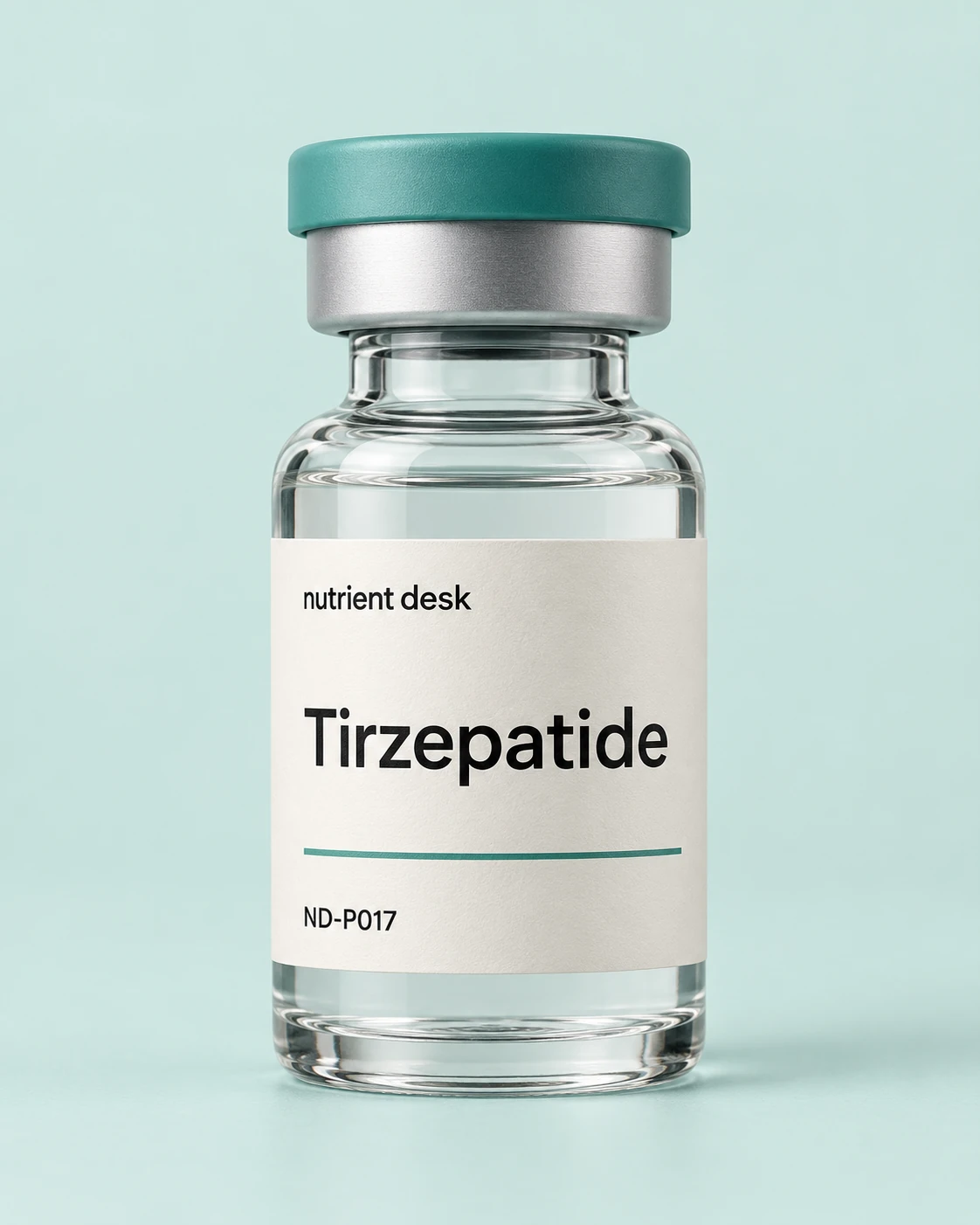
TirzepatidePrescription medicine
A large trial found substantial average weight loss with tirzepatide alongside lifestyle support. The results are encouraging within that setting, but do not replace an individual prescribing assessment.
What is Tirzepatide?
Tirzepatide is a dual GIP and GLP-1 receptor agonist. EU Mounjaro includes weight-management use for adults meeting defined criteria, alongside diet and physical activity. 1
How it works
It activates two hormone-receptor pathways involved in metabolic regulation and appetite. Its clinical results must be assessed separately from those of single-receptor medicines. 1
Effects studied
Weight reduction
SURMOUNT-1 included 2,539 adults without diabetes. At 72 weeks, mean weight changes across three tirzepatide groups were −15.0%, −19.5% and −20.9%, compared with −3.1% for placebo. Eli Lilly funded the trial. 2
Evidence: Randomised placebo-controlled trial; it did not directly compare tirzepatide with semaglutide.
Direct weight-loss comparison
SURMOUNT-5 directly compared the two medicines in 751 adults with obesity and without type 2 diabetes. In this open-label trial, weight fell by an average of 20.2% with tirzepatide and 13.7% with semaglutide at 72 weeks. Participants received their maximum tolerated weekly injection dose: tirzepatide 10 or 15 mg, or semaglutide 1.7 or 2.4 mg. Eli Lilly funded the trial. 3
Evidence: Open-label randomised comparison at specified doses
How participants described daily life
Exit interviews with 86 SURMOUNT-4 participants add a view of daily life. Recalling the initial open-label treatment period, people described less appetite, more energy and easier walking; some also mentioned fatigue or reduced strength. These accounts help identify what matters to patients. They are not a randomised comparison, and the selected interview group may favour people with positive experiences, so the findings cannot predict how often others will feel the same. The study involved Eli Lilly authors. 6
Evidence: Qualitative exit interviews; subjective experience, with selection and recall limitations.
What does the evidence show?
Phase 3 placebo-controlled trial and direct randomised comparison
A treatment with a defined clinical setting
When considering weight-management treatment, three questions help interpret a trial: what changed, who took part and why did some people stop treatment? These details say more about its potential use than describing the medicine as a powerful peptide.
Tirzepatide acts on GIP and GLP-1 receptors. EMA's Mounjaro assessment includes adult weight management alongside reduced-calorie diet and physical activity for specified BMI and health criteria. It is a prescription medicine; this use should not be presented as everyday supplementation. 1
What SURMOUNT-1 found
SURMOUNT-1 randomised 2,539 adults with obesity, or overweight with a weight-related complication, excluding diabetes. At 72 weeks, average weight changes across three tirzepatide dose groups were −15.0%, −19.5% and −20.9%, compared with −3.1% on placebo. The study was funded by Eli Lilly. 2
The range describes different trial groups, not an adjustable promise that a reader can apply to themselves. Individual outcomes varied, and eligibility and follow-up were part of the experiment.
The other numbers worth noticing
Gastrointestinal events were the most frequent adverse events, mostly mild or moderate and often during dose escalation. Treatment discontinuation because of adverse events ranged from 4.3% to 7.1% across tirzepatide groups, versus 2.6% on placebo. 2
Vomiting and diarrhoea can cause dehydration and worsen kidney function. Tell the anaesthesia team about tirzepatide before surgery. It should not be used during pregnancy; pregnancy plans and other medicines need to be discussed with the prescriber. 4
UK MHRA advice is to stop tirzepatide at least one month before trying to become pregnant. People using the pill should add barrier contraception for four weeks after starting tirzepatide and after each dose increase, or switch to a non-oral method with professional advice. 5
How participants described daily life
Exit interviews with 86 SURMOUNT-4 participants add a view of daily life. Recalling the initial open-label treatment period, people described less appetite, more energy and easier walking; some also mentioned fatigue or reduced strength. These accounts help identify what matters to patients. They are not a randomised comparison, and the selected interview group may favour people with positive experiences, so the findings cannot predict how often others will feel the same. The study involved Eli Lilly authors. 6
What a comparison can—and cannot—tell you
SURMOUNT-5 directly compared the two medicines in 751 adults with obesity and without type 2 diabetes. In this open-label trial, weight fell by an average of 20.2% with tirzepatide and 13.7% with semaglutide at 72 weeks. Participants received their maximum tolerated weekly injection dose: tirzepatide 10 or 15 mg, or semaglutide 1.7 or 2.4 mg. Eli Lilly funded the trial. 3
That comparison favoured tirzepatide for weight loss at the tested doses. It does not show that it is better for every patient, every dose or cardiovascular outcomes. 3
Safety & status
Gastrointestinal events were most frequent, usually mild or moderate and often during dose escalation. Adverse events led to discontinuation in 4.3–7.1% of tirzepatide participants, compared with 2.6% with placebo. Full prescribing information remains product-specific. 1 2
Vomiting and diarrhoea can cause dehydration and worsen kidney function. Tell the anaesthesia team about tirzepatide before surgery. It should not be used during pregnancy; pregnancy plans and other medicines need to be discussed with the prescriber. 4
UK MHRA advice is to stop tirzepatide at least one month before trying to become pregnant. People using the pill should add barrier contraception for four weeks after starting tirzepatide and after each dose increase, or switch to a non-oral method with professional advice. 5
Country and product status
EU: Mounjaro is authorised for specified diabetes and adult weight-management uses. Swiss authorisation not checked here.
Frequently asked questions
Is tirzepatide the same type of medicine as semaglutide?
They share GLP-1 activity, but tirzepatide also activates GIP receptors. They are different molecules. 1
Is 20.9% the expected result for everyone?
No. It was a group mean at 72 weeks in one trial, not a guaranteed personal outcome. 2
Further reading
Sources
This entry was rewritten from our research archive. References below are reading leads unless a completed check is explicitly noted; a full independent evidence and regulatory review is still pending.
- EMA · Mounjaro European public assessment report EU regulator · Current EMA overview retrieved via indexed page; direct fetch returned rate limiting. Swiss status not checked.
- Jastreboff et al. · Tirzepatide once weekly for the treatment of obesity (2022) Primary phase 3 trial · PubMed abstract checked; SURMOUNT-1, funded by Eli Lilly.
- Aronne et al. (2025): Tirzepatide as compared with semaglutide for the treatment of obesity; SURMOUNT-5 Primary research · PubMed abstract; full paper and supplements not reviewed; checked 2026-10-29
- EMA: Mounjaro product information EU prescribing information · Indexed patient information: dehydration, pregnancy and anaesthesia; checked 2026-10-29
- MHRA: GLP-1 medicines for weight loss and diabetes — pregnancy and contraception UK regulator · UK advice; not represented as EU product labelling; checked 2026-10-29
- Carmichael et al. (2025): Patient Experience of Treatment with Tirzepatide — SURMOUNT-4 exit interviews Qualitative interview study · PMC methods, results and discussion; author affiliations; checked 2026-10-29
Related names & questions
Connections help distinguish compounds and uses; they do not imply equivalent benefits.
Research provenance
This name was discovered in the Superpower peptide index, archived 26 October 2026. Its ratings and reviewer attribution have not been adopted as our own. The archive informed this original editorial draft; independent source review is still pending.