
CagrilintideAmylin analogue in clinical research
Cagrilintide is a long-acting analogue of amylin, a hormone involved in meal-related fullness. Its standalone evidence should be distinguished from studies of its combination with semaglutide.
What is Cagrilintide?
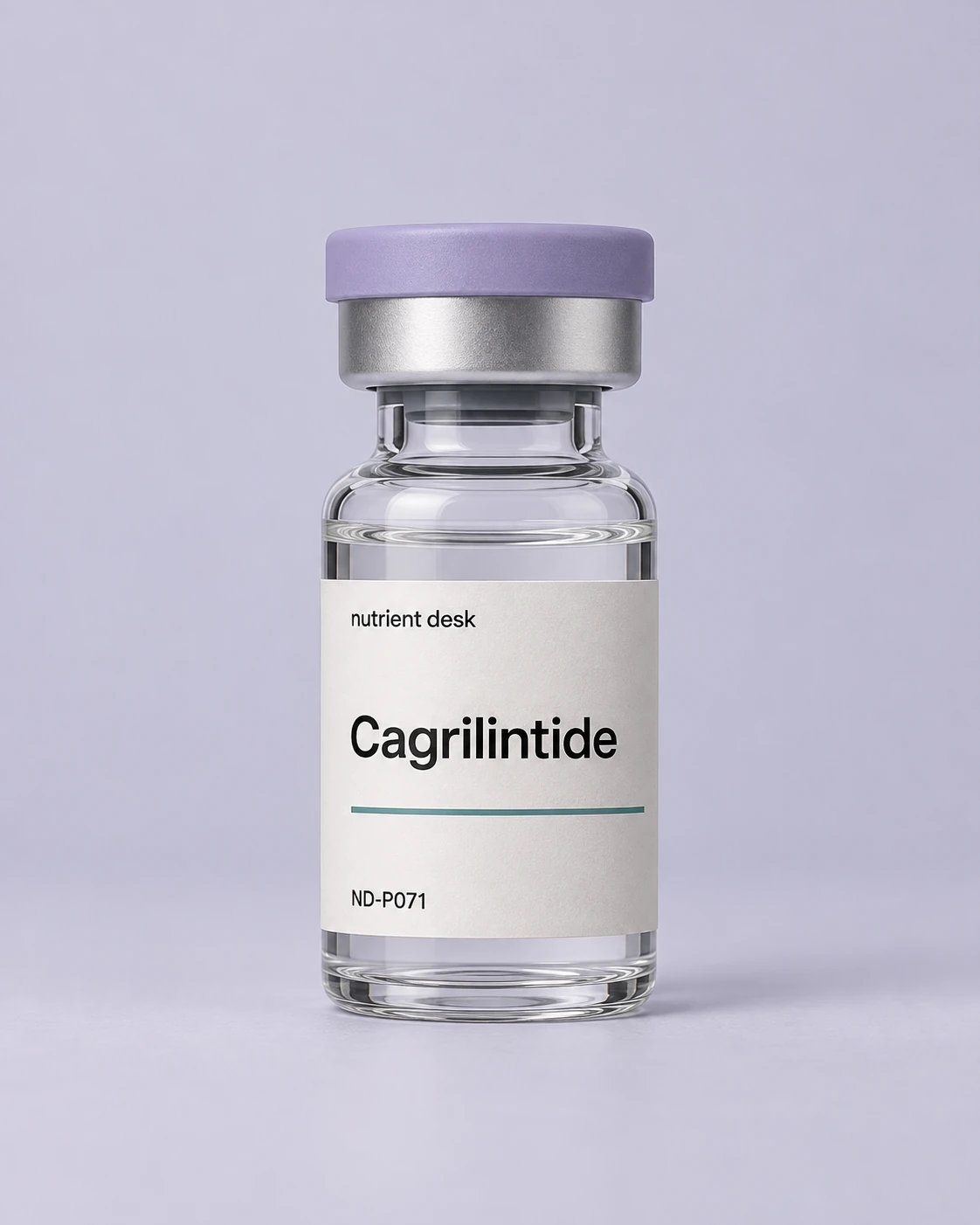
Cagrilintide is a long-acting amylin analogue investigated for weight management. It is also studied in combination with semaglutide.
How it works
Amylin signalling contributes to fullness and influences gastric and glucagon responses to eating.
Effects studied
Weight reduction
A 26-week phase 2 trial randomised 706 adults without diabetes across cagrilintide, liraglutide and placebo groups. In the analysis assuming treatment adherence, average weight loss ranged from 6.0% to 10.8% across cagrilintide doses, versus 3.0% with placebo. Novo Nordisk funded the study. 1
Evidence: Clinical weight-management research; the monotherapy findings should remain separate from combination results.
What does the evidence show?
Phase 2 monotherapy trial and a monotherapy arm in phase 3 REDEFINE 1
Another route to satiety
Amylin is normally released alongside insulin and helps coordinate the response to a meal. Its actions include signalling fullness and influencing gastric emptying and glucagon release. Cagrilintide is designed to extend this signalling over a longer period.
What the standalone study found
A 26-week phase 2 trial randomised 706 adults without diabetes across cagrilintide, liraglutide and placebo groups. In the analysis assuming treatment adherence, average weight loss ranged from 6.0% to 10.8% across cagrilintide doses, versus 3.0% with placebo. Novo Nordisk funded the study. 1
REDEFINE 1 later included a cagrilintide-only group alongside the combination and other comparators. The evidence is therefore no longer limited to this early phase 2 study. 2
Why the combination has its own entry
CagriSema combines cagrilintide with semaglutide, which acts at the GLP-1 receptor. Results from that combination cannot all be credited to cagrilintide alone. Equally, a standalone study does not predict exactly how two medicines will perform together. The comparison groups determine what a trial can tell us.
The experience of treatment matters
In the phase 2 trial, gastrointestinal events occurred in 41–63% of cagrilintide recipients versus 32% on placebo. Nausea, constipation, diarrhoea and injection-site reactions were common. A 26-week study cannot settle long-term safety. 1
Safety & status
In the phase 2 trial, gastrointestinal events occurred in 41–63% of cagrilintide recipients versus 32% on placebo. Nausea, constipation, diarrhoea and injection-site reactions were common. A 26-week study cannot settle long-term safety. 1
Country and product status
Country-specific product availability and authorisation require a separate current check.
Frequently asked questions
Is cagrilintide a GLP-1 medicine?
It targets amylin signalling rather than being a GLP-1 receptor agonist.
Is it the same as CagriSema?
No. CagriSema combines cagrilintide with semaglutide; evidence for the combination is not a result for cagrilintide alone.
Further reading
Sources
This entry was rewritten from our research archive. References below are reading leads unless a completed check is explicitly noted; a full independent evidence and regulatory review is still pending.
- Lau et al. (2021): Once-weekly cagrilintide for weight management; phase 2 trial Primary research · PubMed abstract; full paper and supplements not reviewed; checked 2026-10-29
- Garvey et al. (2025): REDEFINE 1, including a cagrilintide monotherapy group Primary research · PubMed abstract; full paper and supplements not reviewed; checked 2026-10-29
Research provenance
This name was discovered in the Superpower peptide index, archived 26 October 2026. Its ratings and reviewer attribution have not been adopted as our own. The archive informed this original editorial draft; independent source review is still pending.