
Acute Stress
Acute stress is a brief response to a demand or challenge. Supplement studies concern specific laboratory tasks or clinical situations, not a universal way to switch stress off.
What is acute stress?
Acute stress is short-lived tension in response to a challenge, such as a near miss or an argument. It can help with immediate demands. Stress lasting weeks or months is a different, chronic pattern. 1
How does it show up?
The body becomes more alert: the pulse rises and muscles tense. Faster breathing and sweaty hands may accompany an exam or important appointment. People differ in what they find threatening or manageable. 1 2
What do studies measure?
Researchers ask participants how calm or distressed they feel during a demanding task, and may also measure stress hormones or heart rate. Those are different questions: a change in a hormone does not by itself show that someone copes better in everyday life. 3 4
When should stress be assessed?
Medical advice is appropriate when stress feels overwhelming, affects health, or accompanies new or unusual symptoms. 1
Nutrients with the strongest ratings
Sorted by the largest rated effect. Bars show effect size, the letter is the evidence grade.
Which supplements have human evidence?
The examples below separate a single-dose experiment, pretreatment before a laboratory stressor, and anxiety around surgery. These are not interchangeable treatment settings. 3 4 5
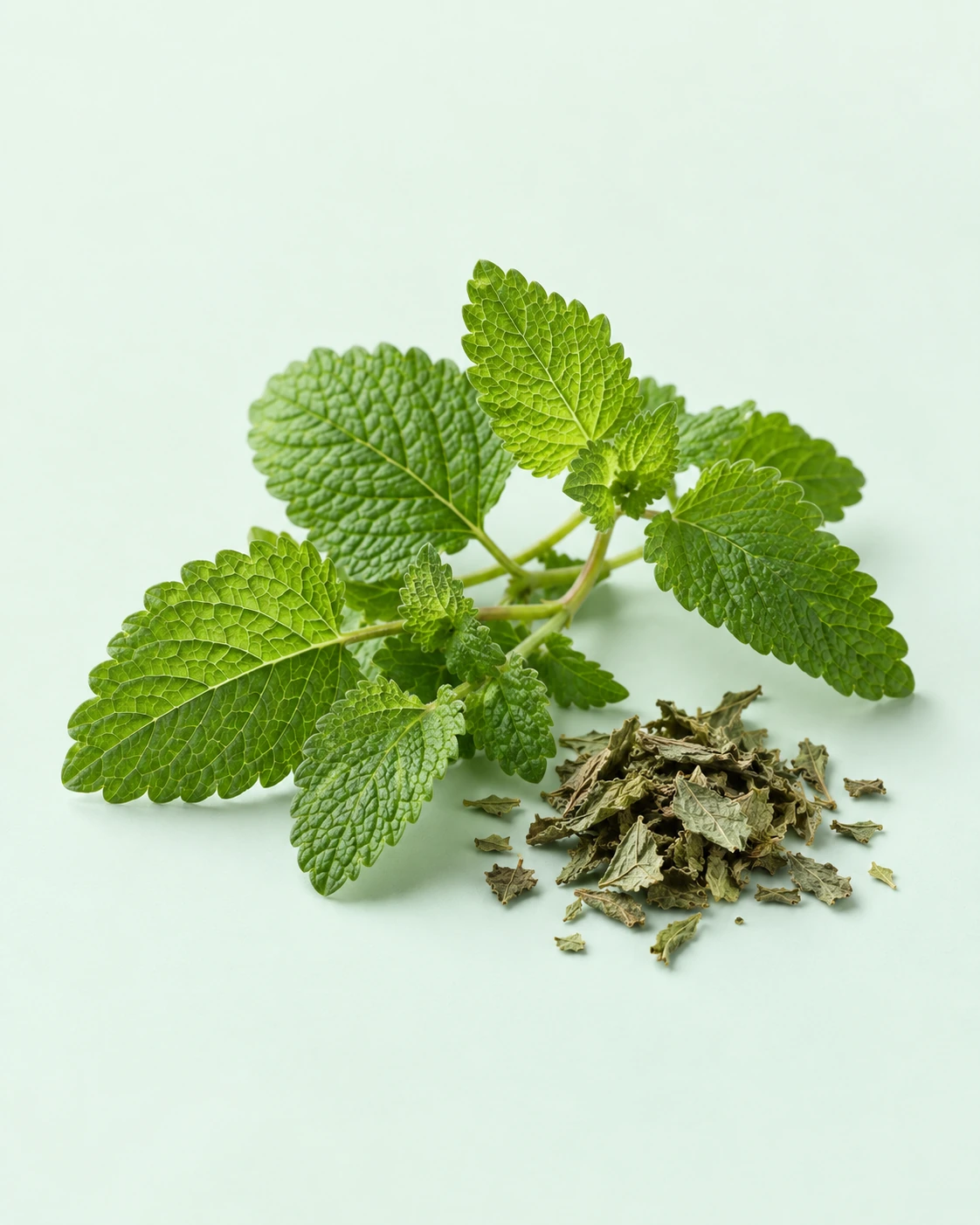 Lemon balmToo little evidence
In a trial where 18 healthy volunteers tested both extract and placebo on separate days, 600 mg of standardized lemon balm increased calmness after one hour during a stressful task. Alertness also fell. This is an interesting short-term signal, with everyday benefits still uncertain. 3
 PhosphatidylserineToo little evidence
Eighty participants received a phosphatidylserine/phosphatidic-acid complex or placebo for three weeks. The 400 mg complex reduced some hormonal and distress responses to the Trier Social Stress Test; higher doses did not. This was a combination, not isolated phosphatidylserine or an immediate rescue treatment. 4
What should not be inferred?
The lemon-balm trial also found lower alertness. In the melatonin review, adverse-event reporting was incomplete and sedation occurred. Feeling calmer and remaining fully alert are therefore separate questions. 3 5
Scope of this page
This page does not review adenosine, caffeine, ginger, L-serine, magnolia bark, reishi or Tinospora cordifolia for acute stress.
What matters beyond supplements?
Recognizing and addressing the trigger, regular movement and deliberate relaxation are practical options. Slow breathing, meditation or progressive muscle relaxation can help some people create a pause during stress. 2
Questions people ask
Is all acute stress harmful?
No. A brief stress response can help a person deal with danger or a demanding situation. 1
Does lemon balm work immediately?
The small trial assessed effects one hour after a dose. It does not establish a reliable benefit for every real-life stressful event. 3
Does lower cortisol prove that I will feel better?
No such conclusion follows automatically. The phospholipid trial measured hormones and psychological responses separately and did not show the same result at all doses. 4
Is melatonin proven for everyday stress?
The review discussed here concerns anxiety around surgery. That setting cannot establish an everyday stress treatment. 5
What can I try besides a supplement?
Identifying the trigger, movement and relaxation practices are options described by the German federal health portal. 2
Sources
- Stress and your health MedlinePlus
- Stress: Auswirkungen auf Körper und Psyche gesund.bund.de
- Attenuation of laboratory-induced stress in humans after acute administration of Melissa officinalis (Lemon Balm) Psychosomatic Medicine, 2004